Showing posts with label music industry. Show all posts

Thursday, November 13, 2014

Music titans, like European royalty, pine for a bygone era

In reading a summary this morning of the record industry’s latest fight with free streaming services, I was struck how much it’s like the laments of former European nobility in the 19th and 20th centuries. Maybe no one lost their head — or had his family wiped out by Boslehvik bullets — but the loss of power is similarly irreversible.

I first researched the industry economics in 2002 while a consultant to Live365 (the earliest free streaming music service). For my technology strategy class at UCI, I wrote a teaching case on the Napsterization of Hollywood, and how both CD unit sales and revenues peaked in 2000 in the face of MP3 piracy.

At the same time, the big six (later five, now three) recording companies consolidated market share from 79% to 83%. They had a cozy oligopoly, the ability to unilaterally set prices, and (as Michael Porter would say) low rivalry. With their limousines and executive suites they were the capitalist equivalent of the 17th and 18th century royalty of Europe.

This morning’s article in the Wall Street Journal was about how the record labels are trying to phase out the access that free streaming services (e.g. Pandora) have to their catalogs:

One major-label executive said he regretted ever having agreed to allow licensees to offer any on-demand listening features free. “In hindsight we made a mistake,” he said.
But one paragraph perfectly summarized the economics of what has happened to the industry in the last 15 years:
An average user of free, ad-supported streaming services generates revenue of around $4 a year to record companies, according to one label executive, compared with between $50 and $75 a user in the record-buying age. Spotify subscribers currently pay $120 a year, of which about 70% goes to record labels and music publishers. Users of free services such as Pandora Media Inc. ’s custom radio service far outnumber those paying for Spotify and its competitors.
In other words,
  • the labels used to have a reliable income stream from the music-buying (teen and young adult) of around $60/year; according to my notes, that totaled $14 billion in the US in 2000
  • that has been replaced by customers who listen to free streaming and pay 93% less.
  • the labels hope the current generation of customers will be nice enough to upgrade to a membership model that pays as much as their former business model. ($84 in 2014 ≈ $61 in 2000)
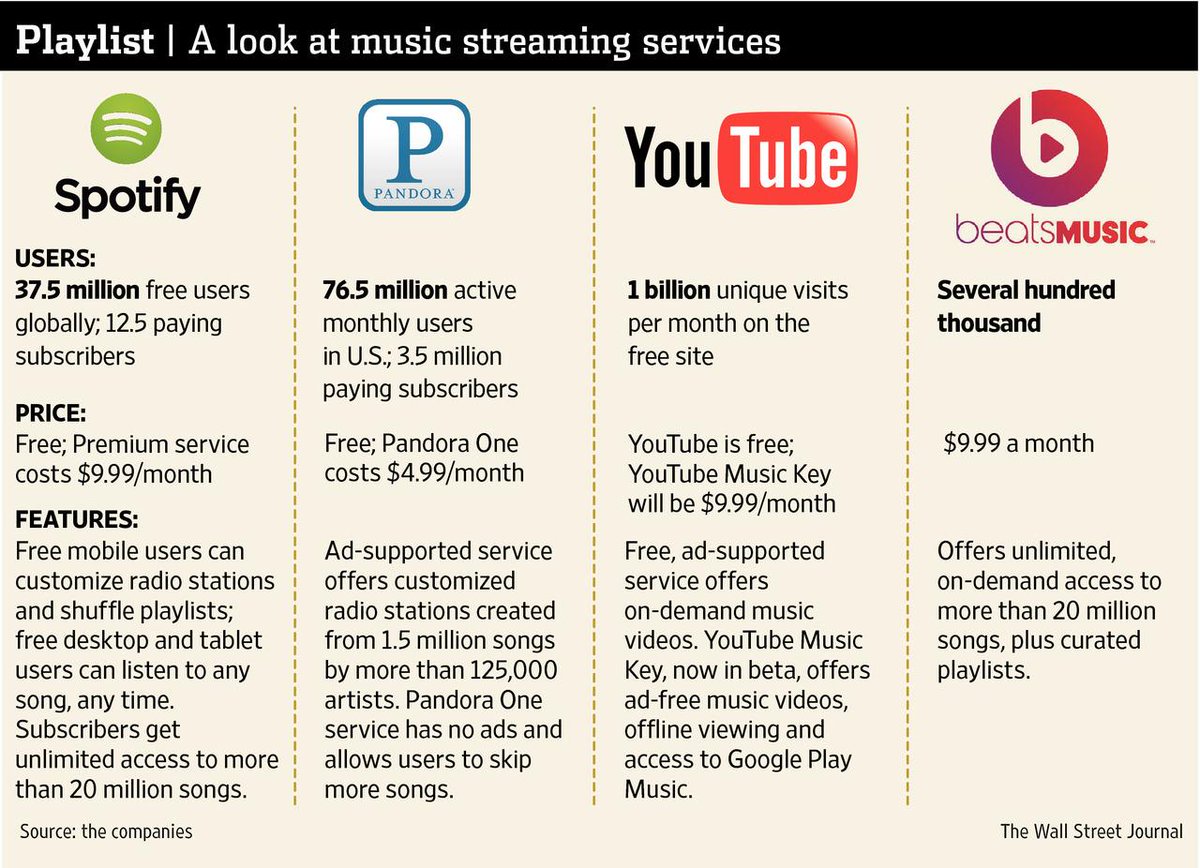
One small problem: customers aren’t interested. The WSJ shows the stats for streaming music
  • Spotify (global) 12.5m paid, 25m unpaid
  • Pandora (US) 3.5m paid, 73m unpaid
  • Beats Music (US) < 0.5m paid
In other words, there are about 6 freeloaders for every paid customer. Google’s new YouTube Music Key (at $10/month) will increase the number of paid users, but probably not appreciably change the ratio. Meanwhile, the services say claim that if they lose the ability to provide a 30 day free trial, they won’t get new paying subscribers.

There does appear to be one royalty that is doing well: the elite entertainers. The article reports Taylor Swift asked Spotify to limit her new album (1989) to the paid service, but the company refused. So instead, Swift pulled her album from Spotify and sold 1.7 million copies in its first two weeks — half of those as physical CDs — and perhaps the only album that will be RIAA platinum this year.

Similarly, Garth Brooks (3rd in US record sales after the Beatles and Elvis) created a new download service called GhostTunes — to host his own latest album. (It also has music by Swift, Pink Floyd and the Foo Fighters). The many zombie bands from the 60s and 70s also seem to be able to generate sales — perhaps from price-insensitive geriatric baby boomers — that insulate them from the pressures of the current market.

So — as my class used to conclude 12 years ago — the ability to set your prices without fear of competition is something every firm aspires to. (PayPal alum Peter Thiel has been saying the same thing recently in his new book, Zero to One). The problem is, there’s no way that Hollywood will ever get their monopoly pricing power back — any more than Luke Skywalker will get back his hand, his dad and his innocence, or that the original Beatles will be finally reunited in the flesh.

Sunday, May 11, 2014

Apple's curious acquisition

Apple’s reported efforts to buy Beats Electronics for $3.2 billion have been the subject of endless speculation since it was first reported Thursday. We don’t know Apple’s actual reason for interest — or even if the deal will happen — since Apple has yet to make any official announcement. (As with all such leaks, this leak seems intended to influence the deal — presumably by the sellers to force Apple to follow through.)

Certainly this is out of character for Apple, since its largest previous deal was $0.4 billion to buy NeXT, the basis of its OS X. But the press frenzy about how precedented the deal is seems a bit exaggerated. After all, there’s always a first time for anything, including its successful acquisitions such as the purchase of NeXT, PA Semi, and Siri. (Google got a lot of flack in 2006 for spending $1.65 billion to buy YouTube).

Is the acquisition a good idea? When we (i.e. strategy professors) teach related diversification by acquisition, there is a standard list of pros and cons.

On the pro side, an acquisition is usually about time to market — accomplishing something more quickly than you could do on your own. It can acquire technology, customers, distribution, products and people. For the latter, Silicon Valley normally thinks in terms of engineers. However, an acquisition can also bring new executives: the NeXT purchase brought in the new management team of Apple — not only Steve Jobs, but essentially it’s entire management team other than the CFO that Gil Amelio installed (Fred Anderson) and the COO Jobs stole from Compaq (Tim Cook).

Finally, there is the opportunity for the newly acquired company to be more successful under its new owner than as a stand-alone company. This might be due to better management, better distribution or more available capital. For example, in our recently completed business plan competition at KGI, most of the proposed startups would sell out to a large pharma or biotech company before bringing products to market, rather than build a global retail sales force from scratch.

On the con side, there is the question of strategic fit: do the new assets fit with the organization, how will the products, people and culture be integrated — and are the business models compatible? The post-acquisition integration can be a huge distraction (but usually when buying a larger company, as with Microsoft-Nokia, Oracle-Sun or HP-Compaq).

And with any acquisition, there’s always the risk of over-paying. Perhaps the assets are valuable, but CEOs have a tendency to overpay — whether to put their mark on their company, grab the headlines or just to run a larger company.

In Beats Electronics, Apple is buying two lines of business. One is Beats by Dre, the headphones division that has nearly two-thirds (61.7%) of the US premium headphone market — nearly 3x that of Bose, which created the segment.

It’s a monstrously successful brand, but there’s little technology there. The two music industry execs who formed Beats outsourced their initial headset design to the father-son team that runs Monster Cable Products (which, lacking negotiating savvy, failed to get an equity stake in the venture they helped create). The success of the company (even more so than for Bose) is based on marketing rather than technology:

"They certainly don’t need the headphone company, which makes second rate headphones based on marketing," says music industry analyst Bob Lefsetz. He thinks Apple would be a lot more interested in Beats’ music streaming service. Steve Jobs famously opposed the subscription music model and, instead, championed iTunes' current model, where you buy a song outright.
This points to its other line of business. The nascent Beats Music steaming service leverages the value of the Beats brand with teens, but (like Apple and Amazon) is far behind market leader Spotify.

By one standard, Apple is certainly overpaying. The company’s exponential growth is not sustainable and its revenues are less than $2 billion. As a company with little technology and strong emphasis on style and brand, Beats is essentially a fashion company. Any fashion acquisition is a risky acquisition.

Will Beats by Apple seem as authentic or appealing to teens as Beats by Dre (when Dre was still the owner)? For that matter, how many fashion companies are able to sustain their position of a period of decades? In my adult lifetime, I can only think of one firm that has been successful: Nike.

Which brings us to the final possible value of Beats. The company has shown it has been able to understand teen fashion and create markets that didn’t exist. Is that because of the cofounders, Dr. Dre (aka Andre Romelle Young) and music mogul Jimmy Iovine? Or is there a depth of marketing — both market sensing and market creating — within Beats that could help Apple better sell unnecessary luxuries to middle class teens and college students?

Although it’s a large deal for Apple, it’s essentially a minor bet — hardly on the scale of Google buying YouTube or WhatsApp, let alone Microsoft’s purchase of Nokia.. Apple has more than $150 billion in cash (mostly offshore), and has few other options to create meaningful growth. With annual revenues of more than $170 billion, the Beats sales would not be material to Apple any time in the near future — if ever.

So if Apple gains an additional window into the soul of the 13-25 year-old set — or rebuilds its foothold in the music industry — then the deal could prove to be a shrewd one. As it is, it’s a gamble — but Apple didn’t get to where it is without taking gambles (such as the iPhone). It may be Tim Cook’s largest gamble to date, but it won’t be the last one he takes as CEO.

Sunday, October 7, 2012

Is Pandora boxed in by supplier pricing power?

The 1990s brought numerous dot-com companies that never turned a profit, but had a “business model” of selling themselves to the greater fool, whether it be public shareholders or acquisition by a large firm. (This trend confused my students, who after several years of bad examples thought flipping a money-losing company counted as creating a business model).

Most of those companies are long gone. Instead, we have Pandora, which has yet to show a profit since its June 2011 IPO, but has a market cap of $1.7 billion.

To be fair, it has survived predictions of failure from four years ago. In a difficult market segment where firms have little control over costs (i.e. royalties), Pandora remains the most successful Internet radio service of all time, with Last.FM swallowed up (and largely forgotten) within the bowels of CBS, Live365 remaining privately held and most of the other firms now defunct.

The recent interest (and speculation) in Pandora centers on Apple’s rumored plans to create its own music streaming service. (More recent accounts say Apple’s plans have been delayed by the greed of the same record companies that make it impossible for Pandora to turn a profit.) The speculation knocked Pandora’s stock off its highest price since March, but other than that temporary blip, the stock has been trading in a range of $10-11 per share for nearly five months — although below its $16 offering, that would be a raging success by Facebook standards.

Now some (including Business Week) speculate that Apple’s interest will prompt Apple’s major rivals to buy Pandora to compete. Google competes with Apple on cellphone platforms, while Amazon is its major competitor in music streaming.

This comes despite analyst predictions of 2012 Pandora losses nearly doubling to $30 million. As with three years ago, Pandora is losing money on every sale but making it up on volume. (Thanks to the IPO, the company’s balance sheet is solid enough weather several years of such losses, even without any secondary offering).

Business Week even speculates that Clear Channel might be interested in supplementing its online service with Pandora (much as CBS bought Last.FM). This seems the least plausible, given all Clear Channel has spent on iHeartRadio, the mobile clients and even live concerts to promote the brand.
So as in the dot-com era, we have the hope that losses will be redeemed by a beneficent acquisition before the company runs out of money. But where is the business model? If it’s not possible to make money with current pricing (and cost structure), will volume solve the problem?

From following the cost structure of Internet radio for more than a decade, I see no cause for optimism. Facing a collapse in their core business, Hollywood labels hope extract every penny from newer (and smaller) channels, including Internet streaming. The bigger and more successful Pandroa gets, the more money record companies will seek to extract. Like a Dumas musical, it’s unlikely to turn out well for the protagonist.

Wednesday, December 9, 2009

Viva Vevo

Tuesday was the North american launch of Vevo, the music video site owned by Universal, Sony and money from Abu Dhabi Media

I find it encouraging that the record labels are taking this step. Faced with the decimation of their decades-long revenue model — the sale of tangible music discs — they are making pro-active experiments. If the plane is losing altitude, at least they’re trying to pull up rather than the controlled flight into terrain of so many other industries afraid of cannibalizaiton.

Of course, this is a very mild step — stealing back unmonetized content views from YouTube in (probably forlorn) hopes of gaining meaningful revenues. Still, if it crashes and burns, it’s better than the controlled flight into terrain that most of Hollywood is on.

It’s interesting to see what it does to YouTube, since, — as Wired notes — most of the most popular videos are music related. By my count, before Vevo launched 14 of 24 the videos with 60+ million views were owned by labels or artists.

As the LA Times notes, this is the music industry’s version of Hulu — i.e. yet another Universal anti-YouTube site. The Times is skeptical about claims made Tuesday about how revolutionary it is:

Bono's opening remarks were quoted by Billboard: "Friends, we are gathered here today to mourn the passing of the old model that was the music business."

Perhaps Bono has some inside information on what Vevo ultimately will become. In a quick summary, Vevo offers on-demand streaming of music content with advertisements. YouTube offers the same, without the ads, and more content.
I agree with the Times that the business model is suspect: it doesn’t work all that well for YouTube at monetizing, even if Vevo has less of the drek cluttering up the site (like all the fake videos.)

For now, it also doesn’t have videos from my favorite bands on WEA (or anything else from Warner Music Group.) Perhaps the record cartel has a plan for the firms to take turn swimming against the industry tide to make it seem less cartel-like.

Of course, some of this is correcting the original MTV mistake — giving away music videos as advertisements for the real content, rather than treating them as valuable in their own right. But then that horse escaped the barn nearly three decades ago.

Will the labels offer their content on reasonable terms to other online channels? Or will the other channels decide that the numbers can’t be made to work, long before the labels throw in the towel?

Monday, October 19, 2009

Not many Nokias come with music

Nokia has wanted to be a vertically integrated mobile services and devices company. It its own app store, its own maps and its own music service.

How’s that working out, Nokia? The data is in on the latter, as PaidContent (and others) report:

Free unlimited music for more than a year seemed like a good proposition, but, nine months after its launch, Nokia’s Comes With Music bundle is not proving particularly popular with consumers.

In July, the scheme had just 107,227 users across the nine countries in which it’s launched, according to figures Nokia (NYSE: NOK) sent out to labels and distributors, obtained by MusicAlly:
By comparison, PaidContent mentions that Spotify has 6 million users. As of May, Pandora claimed to have 4 million iPhone listeners. Sirius XM radio quickly got 1 million downloads for its music app (although it’s not clear how many of those pay the monthly fee.

The granddaddy of them all, the iTunes Store, has sold more than 6 billion songs, even if most of them (so far) are only for use on PCs.

PaidContent’s assessment:
Nokia has placed a lot of importance, and a lot of marketing money, on Comes With Music. But the programme has been hampered by DRM and complex PC operation and confusing PC-mobile sync. And that advertising campaign has really failed to communicate exactly what CWM means.

Even the official blog on which Nokia is celebrating CWM’s first birthday acknowledges: “Sure, it didn’t start out that rosy, with lots of folk not really certain about what Comes With Music offered ... we never shied away from the important education process that is needed in order to fathom that you can download and forever-keep as many tracks as you like – but the past 365 days have seen a much greater understanding and appreciation for the service emerge.”
DRM is dead, simplicity and ubiquity are in. It sounds like Comes With Music has a long way to go. Is it the problem with the product concept? The execution? The business model?

Whatever the problem, it’s clear that the benefits of vertical integration (compared to all the point solution rivals) are minimal for Nokia. One could argue that vertical integration has paid off handsomely for Apple, but for the past decade the company also had the best execution in the IT industry for product design and ease of use. The point products can’t copy Apple‘s vertical integration, but they can hope to copy (or surpass) its other advantages.

If my experience with my Nokia E61 and S60 is any indication, Nokia is a long way from winning awards for ease of use.

Sunday, August 16, 2009

Talking about my generation

This weekend is 40 years since Woodstock — the event that had 500,000 people in a muddy field in upstate NY. (I wasn’t there — I was too young and it was too far away — but I did attend the 1982 US Festival in which Steve Wozniak spent his millions to get the Police, Cars, Kinks, Santana, Tom Petty, Pat Benatar, Jackson Browne and Fleetwood Mac all in one hot and dusty county park.)

In honor of the occasion, the normally serious Pew Research Center asked 1,815 Americans (16+) ostensibly about the generation gap, but mainly about their taste in rock music.

While the survey doesn’t cover sex and drugs, it’s clear that rock ’n roll has won as yesterday’s boomer children are today’s middle aged parents:

Two-thirds of respondents say they listen to rock often (35%) or sometimes (30%), placing it ahead of the six other musical genres tested in the survey: country, rhythm and blues, hip-hop, classical, jazz and salsa.

Back in 1966, a national survey found that rock and roll was by far the most unpopular music in the country. Nearly half of adults (44%) said they disliked it, and only 4% said it was their favorite kind of music.
Looking at the raw numbers, the top artists across all ages were
  1. Beatles
  2. Eagles
  3. Johnny Cash
  4. Michael Jackson
  5. Elvis Presley
  6. Aretha Franklin
  7. Frank Sinatra
They only sampled 20 artists, and so some of the results are skewed by who made the survey and who didn’t. So Aretha Franklin (40 year career) is there but not the Temptations (more #1 hits); the Grateful Dead (more rabid following) but not Led Zeppelin (broader following).

Perhaps more interesting were the generational breakdowns, the “never heard of” figures and the “dislike” numbers. Country stars generally had higher dislike figures, but — not surprisingly — Madonna topped out on the dislike figure a 31%. (Coldplay — best known for Viva La Vida — topped out the unknown at 45%). Most of the top 7 acts had single digit “haven’t heard of” figures, with 1% for the Gloved One, 3% for The King and 4% for the Fab Four.

Interestingly for me, the top act for adults aged 30-64 was the Eagles, authors of the best-selling album of all time. (The 29.4 million albums sold seemed unlikely to be eclipsed until Michael Jackson nostalgia moved “Thriller” into contention for the top spot). This was a favorite album for both my sister and I, while I still use her childhood piano book (of said hits) for regular practice of my garage band (even if I’ll never be able to match the harmony vocals of a Randy Meisner).

The Eagles are unknown to 16% of the sample (presumably under 30 or over 65), by far the highest in the top 7. It could be that their lack of airplay since their first breakup in 1980 is the problem. But if you look at it, Elvis (who died 32 years ago Sunday), Michael Jackson and Madonna all have smaller unknown figures — not because of their music, but because of their personal notoriety for their non-musical proclivities.

So oddly, the Eagles are less known because they carefully managed their public image. Anyone who’s read the Don Felder tell-all memoir knows the Eagles had the normal rock star proclivities for sex and drugs, even if they couldn’t keep up with Aerosmith or the Stones on the former or the Grateful Dead for the latter.

Only four of the 20 made the top 50 of the Forbes Celebrity 100: Madonna, the Boss, Coldplay and Kayne West — with 2008 earnings above $50 million. Most of the biggest names are either dead or semi-retired, even if Sir Paul ended 2008 about $50 million poorer than he began it.

Update Monday 11am. Alas, Bob Dylan is even less well known by today’s 20-somethings than I thought possible. I really liked the reader comment on that story: “ How does it feel… / To be without a home / Like a complete unknown / Like a rolling stone?”

Saturday, June 13, 2009

Passages

At Open IT Strategies, we introduce a new section: “Passages.”

NTSC. (1953-June 11, 2009). Sometimes referred to as “Never Twice the Same Color,” this analog encoding system for broadcast television was the standard for the United States and key export markets for more than a century. Cause of death: DTV transition; complicit in its death: Congress, FCC, National Association of Broadcasters and many others. Survived by ATSC.

Record Store Chain. (1960-2009). The chain has been on life support since 2006, with the death of Tower Records. The last surviving record store chain, Virgin Megastore, is expected to breath its last breath on June 14 with the closure of its remaining NYC and LA stores. Cause of death: starved to death with the death of the CD at the hands of Napster, iTunes Store and Amazon.

Wednesday, April 8, 2009

Amazon gains on iTunes

By leading the way on DRM-free downloads, and on the strength of a joint promotion with Pepsi, Amazon is apparently gaining share on Apple’s iTunes store.

CNET quotes NPD as saying that in 2008, 87% of US digital music buyers used iTunes and 16% use Amazon (I would have expected more overlap).

Some 18 months after launching, Amazon is now in a credible 2nd place, at least in the US market. It appears — as the Big Four labels intended — that Amazon is having more impact on Apple than I had assumed.

Both Apple and now Amazon and Wal-Mart will be charging more (as labels long demanded) for current, more popular titles.

However, PaidContent (great site) has some news that has to be worrying for Apple’s rivals. Citing a Piper Jaffray report, Joseph Tartakoff writes:

…a new report from Piper Jaffray says that iTunes is now essentially the only option teens consider. Forty percent of high school students in the investment research firm’s bi-annual teen survey legally purchased music online. Of those, 97 percent said they used iTunes, up from 81 percent a year ago. Piper Jaffray attributes the growth in large part to slowing momentum from newer competitors, like Rhapsody, eMusic and Amazon MP3.
The way I read this:
  • Amazon is cross-selling MP3 files to its core customer base — people in their 30s and 40s who saw Amazon as breakthrough technology when it came out during the dot-com era.
  • Apple has a lock on selling trendy iPods to the affluent teen market where parents out of guilt pay for their kids’ legal downloads.
  • Kids whose parents won’t pay for downloads are using second-tier players and bootlegging music.
This is a really odd business relationship. On the one hand, Apple gives the labels exactly what they want: creating a new market that gives people a chance to buy legal downloads, and perhaps prevent an entire generation (just most of it) from thinking digital music is free music. The labels repay it by encouraging rivals like Amazon to Apple to put pressure on it.

In turn, Apple complains bitterly to the public and regulators that the big bad labels made it use DRM. When the labels help Apple’s rivals go DRM free, then it uses that precedent to ditch DRM too, enabling the same music copying problems the labels vowed to prevent.

I would say that’s just business, but this is a particularly thorny problem for which there is no good answer. Or perhaps we just have a test of wills between the one and only Steve Jobs-sized ego against Hollywood-sized egos (which are pretty big too).

Monday, March 30, 2009

Between a rock and a hard place

There‘s an old joke about “losing money on every sale but making it up on volume.”

This seems to be the looming collapse facing much (if not most) of the Internet streaming sites, as outlined by Monday morning’s Financial Times.

The article lists a double whammy: implacable royalty demands by music copyright holders and limited willingness to pay. To the former

Michael Bebel, who ran Ruckus says: “The labels have to understand that the ad market in this space is still developing,”.

“This means that they need to be happy with a revenue-share model that is not all that significant in terms of per-play.”
For the latter, substitutes limit pricing power:
The music industry will try to squeeze more money out of Apple’s leading iTunes store next month, when Apple will begin charging $1.29 in the US for the most popular songs, up from 99 cents.

But that will not make up for the revenues missed through illicit trading.

“The market leader isn’t iTunes. The market leader is free,” says Ged Day, the founder of early download site Bleep.com.
The article lists two dead sites (SpiralFrog, Ruckus) while other sites are either cutting costs (Imeem) or increasing prices (Last.fm).

Not mentioned is the longest-established streaming site, my former consulting client Live365, which now has a subscription based model in addition to ad revenues. Also missing is Pandora, the popular free streaming site for PCs and mobile phones that added ads earlier this year.

Normally we would expect the distribution channels to self-correct: if they can't pay the bills, either the entire industry will increase prices or the suppliers (labels) will moderate costs.

I don’t see the latter happening because the recorded music industry is essential a four-firm oligopoly. If anything, the track record with Hulu suggests that Hollywood would rather control the distribution channels (and any money) rather than help 3rd parties survive.

WIthout better options on either the supply or revenue side, these streaming sites are between a rock and a hard place.

Thursday, February 12, 2009

Ticketmaster trouble ahead

OK, so I was wrong when I said analog TV would end next week (serves me right for believing the government). But it looks like I got one prediction right.

Open IT Strategies, Februrary 8:

The change in administration is also going to bring a change in antitrust policy, something that (unlike economic stimulus) can happen relatively quickly.
Wall Street Journal, February 12, p. B2:
Two Democrats in Congress called on the Justice Department Wednesday to block the merger of Live Nation Inc. and Ticketmaster Entertainment Inc., an early salvo in what promises to be a test of the Obama administration's effort to strengthen antitrust enforcement. …

Christine Varney, President Obama's pick to head the Justice Department's antitrust division, is a former commissioner at the Federal Trade Commission with a reputation for favoring tough enforcement.
The folks at Ticketmaster may be rapacious, but they’re not stupid. Look for them to frantically make concessions — particularly those that these grandstanding politicians can trumpet as helping the “little guy” — in hopes of saving the deal.

Sunday, February 8, 2009

An easy change to make

In his first month, the focus on President Obama’s policy choices has been his tax and spending policies. Given the fight over the $800? $900 billion in new spending (plus the $300b blank TARP check that Tim Geithner gets to spend) this is not all that surprising.

However, the change in administration is also going to bring a change in antitrust policy, something that (unlike economic stimulus) can happen relatively quickly.

It's not clear how dramatic the change will be, but given that Sen. Obama was clearly to the left of where Gov. Clinton was, it seems likely that this will be the most aggressive regulatory environment since Carter if not LBJ. The contrast will be dramatic, coming after the Bush administration, which next to Reagan was clearly the most laissez-faire postwar regime when it came to economic policy.

Two big test cases are coming up on antitrust regulation (called “competition policy” everywhere outside the US).

The easiest one will be the disposal of the excess licenses that Verizon Wireless acquired in its Alltel acquisition. As has been true with cellular mergers for nearly 20 years, the acquiring party must divest one license (usually choosing the weaker one) in any market where it would significantly reduce competition through the combination.

The WSJ reported last week that AT&T wants to buy the licenses that Verizon is divesting. AT&T has the most money and so would either give Verizon the best price or at least push up the price in a bidding war. (Sprint us unlikely to be able to bid given its problems). The problem is, AT&T has about 28% share and Verizon has about 31% share, so the acquisition would decrease competition more than letting the licenses go to the #3, #4 carrier or some private equity group (which hopes to flip it someday to a big 4 carrier).

So unless some AT&T exec has an insider relationship with the Obama administration (like Bernie Schwartz to Clinton or the Texas oil industry to Bush), this seems like an easy bid for Obama’s antitrust appointees at FCC to reject.

The more problematic — both legally and politically — is the pending merger between Live Nation and Ticketmaster, providing vertical integration in delivering live rock concerts. Ticketmaster essentially has a monopoly in reselling concert tickets, so it would normally be subject to the strictest scrutiny in its actions.

However, Live Nation’s plans to compete with Ticketmaster are only incipient and not fully realized. Plus the vertical integration could deliver some efficiencies. Finally, as with artists vs. record labels or actors vs. producers, Hollywood (and its political donations) are at least somewhat split here and not speaking with one voice.

The Obama administration has yet to tip its hand on antitrust issues, so there are no indications how strict it will be. I would not be surprised if the new administration ends up blocking both efforts — AT&T’s acquisition of Verizon Wireless assets and Ticketmaster’s purchase of Live Nation. I would also not be surprised if the efforts are allowed to proceed with restrictions. About the only thing that would surprise me is if both were allowed to proceed with few if any restrictions, the sort of Bush-like outcome that the president (and his allies) vowed to eliminate.

Wednesday, January 7, 2009

Best deal at Macworld Expo

My favorite stop at Tuesday’s Macworld Expo was at the Berklee College of Music booth. I saw them last year at the Expo, but this year they have an even bigger booth (4302) in Moscone North.

I never heard of Berklee until I went to MIT, but then they were around the corner from where I lived (briefly) in Back Bay. The founder was an MIT alumnus, and his son expanded the mission to include both on both the business of music and electronic music.

At Macworld Expo, some of the Berklee faculty were giving free demos on making music using a computer. It was very practical, grounded in how actual musicians work, and (unlike most booth demos) was not pushing a particular product or set of features.

The full schedule is published online. I saw “Mac for the Guitarist” (Tue 4pm, Wed 1pm) but “Making Music with the Mac” (Tue Wed noon) was highly recommended.

I stopped to ask: “why is Berklee doing this?” (If I were asking a SV firm rather than an arts college, I would have said “what’s the revenue model?”). This is the answer I got:

  1. Berklee has one of the largest college installations of Macs around — some 2000 new machines for students every year — perhaps the most(?) for a music conservatory.
  2. They want to raise their visibility on the West Coast, to get away from being primarily a regional school with a student body fro the Northeast.
  3. Finally, the show management (IDG) gave them space for free — a lot more space than last year (there was clearly plenty of free space).
This is not out of character for Berklee: one of the slides mentioned BerkleeShares.com, a website for free self-paced music instruction available around the world. Effectively, Berklee is doing for music education what MIT (just across the Charles River) is doing for science and engineering with its OpenCourseWare initiative.

I think it’s great that Berklee’s doing this, and I hope that it continues in some format after Macworld Expo disappears.

Saturday, January 3, 2009

Music industry: bad news keeps on rollin'

As with previous three years, digital downloads are up but CD sales and total revenues are down. The new wrinkle is that sales of vinyl albums have hit a record — at least for the 18 years they have been tracked.

The data reported by the various news articles use Soundscan data, which by definition is only US and Canada.

Nielsen SoundScan is an information system that tracks sales of music and music video products throughout the United States and Canada. Sales data from point-of-sale cash registers is collected weekly from over 14,000 retail, mass merchant and non-traditional (on-line stores, venues, etc.) outlets. Weekly data is compiled and made available every Wednesday. Nielsen SoundScan is the sales source for the Billboard music charts.
Facing this sort of bad news, the labels are doing what they can, but so far nothing is working:
In an effort to cope with changing technology and the threat of Internet piracy, the recorded music industry has been exploring new sources of revenue. Royalties from satellite and Internet radio and so-called 360 deals with artists, in which the label shares in concert ticket and merchandise sales, contribute to the labels' bottom line. Video games such as "Rock Band" and "Guitar Hero" also generate licensing fees.

Nielsen doesn't track those alternative revenue streams, which are not yet large enough to offset the decline in CD sales.
Of course, the story would be even worse overseas, where the pirated vs. paid download fight may be already lost.

On an evening when our PBS station is replaying a 2007 “British Invasion” reunion concert for the umpteenth time, another noticeable trend of the Soundscan data was the absence of “classic rock” artists among the leading digital songs and artists. This appears to draw a clear cultural (and technological) boundary between the album-oriented era of the boomers and the digital downloads favored by millennials.

The best-selling US albums of all time are dominated by older acts. Of the top five albums, all are by bands (or artists) that began their recording careers in the 1960s or 1970s — as are 8 of the top 10 and 19 of the top 25. Given declining album sales, those are records unlikely to be broken.

For 2008, the leading digital songs and artists were those from the past 15 years. (The one exception was Madonna, who was paired with a boy band star who started in 1995). Of course, these are leading in an era when more digital downloads are stolen “shared” than paid for.

When today’s consumers are paying less money to artists than did their parents (or grandparents), obviously it’s less lucrative to be a rock superstar. Will this declining ability to monetize also mean a concomitant decline in their cultural impact? Or has the declining value of superstar-dom come from the fragmentation of the distribution channels — the end of top 40 radio and similar gatekeepers?

Such a fragmentation of distribution has had a profoundly democratizing influence on books and the news media. There are signs that the “long tail” is having the same effect on the music industry.

Friday, January 2, 2009

Amazon and Pepsi: Thanks for the memories

When others were readying to ring in the new year, I spent more than an hour scrambling to use up my last 94 points from the Pepsi Stuff promotion. As promised, the website and Amazon’s page disappeared on Jan. 1, even if the Facebook page remains live.

I think the promotion was well designed and well executed. Announced in January and launched with a Super Bowl ad, the promotion began Feb. 1 and ran for 11 months.

This was Pepsi’s second effort to seed digital downloads, following its earlier cooperation with Apple’s iTunes Music Store. With its 2003 press release and a 2004 Super Bowl ad, Apple and Pepsi announced plans to give away 100 million songs, but only about 5 million were redeemed. A second promotion (twice as big) ran in 2005, although both the first and second contest allowed cheating.

Both the original Pepsi promotion and the 2008 successor were effective with me. In the most recent case, I signed up with Amazon, installed its downloading application, and bookmarked its webpage for weekly “MP3 Deals”.

Mainly through my wife’s (two case/week) Diet Pepsi habit, at one point per sixpack I accumulated 259 points: 180 for songs (36 songs), 75 for a t-shirt, and 4 that went unused. I downloaded 36 songs with Pepsi Points — 18 in the final four hours of the promotion. 21 songs were classical albums (one song at a time), most of the rest were singles from groups where I didn’t want the albums.

But the promotion was also effective at shifting my attention during this period from iTunes to Amazon. In some cases, the cost per song on the MP3 Deals was too good to pass up: I bought five albums (with 9-21 songs each, most at $5): two classic rock albums, one classical album and a Xmas album each for my wife and daughter. I bought five singles, three of those Xmas songs.

I originally thought the UI was clunky compared to iTunes, and there were serious problems due to the web page metaphor. On multiple occasions, I unintentionally interrupted the download (but not the purchase) by backing up in the browser, leaving me with no song; tech support had to manually make the song available. This is something that would be easily fixed if every purchase opened a new page.

Because Amazon requires one click purchase for songs — something I otherwise disable on my Amazon account — I also accidentally bought one song I had no intention of buying because I clicked on the wrong part of the UI. (Given we’re in America, this seems like a lawsuit waiting to happen when someone with poor vision or motor skills claims fraud due Amazon’s policy.)

On the other hand, I thought the Amazon merchandising was much more clever and aggressive than Apple’s staid and dated site. Apple offers one free song a week, which (I expect) will always be something oriented at its teen demographic. Amazon offers dozens of free songs, which caused me to linger longer at the site; the $5 albums certainly caused me to keep coming back every week, particularly since one was usually a classic rock album aimed at my demographic (such as “Dark Side of the Moon,” which I once owned in college but never acquired as a CD).

Both sites have restrictions on downloads, many of them obviously imposed by the labels. The premium classical brand, Deutsche Grammophon (one of four classical music subsidiaries of Universal Music Group), marks at least one song of every piece (e.g. symphony) as “album only,” forcing customers to buy the entire album. On the other hand, Amazon’s variable song pricing makes sense for longer cuts (such as a 15-minute movement from a classical piece) than the standard 3-5 minute single on a pop album.

Amazon also has DRM-free, while Apple’s efforts to shift to DRM-free have stalled after only EMI decided to cooperate. The iTunes DRM system works reasonably well, but every so often is intrusive to the point of being irritating.

Apple is still the market leader in music downloads, with five billion songs as of last June and perhaps an official announcement of a new total (seven? eight? billion) next week at Macworld. As with the Kindle, Amazon is not saying how many songs it has provided, only the number of songs available.

Overall, I think Amazon managed this promotion very effectively, using it to reach second place in the (U.S.) download market. Still, it’s not clear whether I’ll be back to the Amazon store now that I no longer have Pepsi Points to spend.

Digital music files are a commodity for me: it doesn’t matter whether I download them from Amazon, from iTunes, or buy a used CD and convert it: the main driver is price. The CD is usually cheapest if I want an album, while the downloads are cheapest if I only want one song (assuming the publisher allows it to be sold ala carte). It’s easier to compare prices between Amazon and iTunes (or between Amazon and its used CD sellers) than it is to go to a physical Wal-Mart and Target, and anything that makes price-shopping easier fuels commoditization.

The record labels have done everything they can to enable Amazon’s entry to fuel competition to Apple and reduce its channel power. To the UCLA and USC MBAs running the record labels, this must have seemed like a no-brainer application of the “supplier power” concept of Porter’s Five Forces.

However, lacking a quality or easy of use advantage — or any sort of differentiation other than DRM-free and integration with the Amazon catalog/buying system — Amazon has been aggressively using price to gain market share: free songs, bargain albums, songs at 89¢ or 79¢ each. This further encourages shoppers to price shop, reducing the perceived value of digital downloads and increasing commoditization.

Between pirated content and distribution alternatives, the music industry is further along the commodization path than is its video counterparts. I can’t see a scenario (even in the short run) where the labels can push through a price increase (as does the movie industry) to Amazon and iTunes, and with commoditization I’d expect music publishers’ average per unit revenue in real dollars (not to mention unit sales) to be lower a decade from now than it is today.

Tuesday, October 28, 2008

My favorite new song stealing site

Since 2000, a buddy and I have had a never-ready-for-prime-time garage band: two guys covering 70s music without an audience (unless you count our daughters).

Over the weekend, we were trying to learn a classic Sam Cooke/Lou Rawls tune, but neither of us had the MP3 file. (When I got home, I bought the MP3 file from Amazon).

So my buddy said, “let’s try Project Playlist.” Sure enough, it had a wide range of versions of the song available for streaming — all free. The search image would link to the various websites that had copies of the song for us to hear.

The company apparently isn’t paying royalties to the record companies. This seems to be the model for a startup based on redistributing other people’s content (like Deezer or GooTube): launch your company, distribute content, solicit revenues, and figure out how to pay for your inputs later.

It’s no wonder that the RIAA sued Project Playlist in April. The company’s defense (as quoted by CNET):

“We make it easy for our users to create a playlist that points to a series of music files hosted on third party Web sites,” Project Playlist said on its site. “We do not control those third party Web sites. We do not host music files.”
This is exactly the same loophole as SurfTheChannel attempts to use for videos.

The company has high powered lobbyists and is trying to negotiate a deal with Sony BMG, and (it hopes) eventually the other three members of the Big Four.

We also tried last.fm, a legal interpretation of the same theme. At last.fm, we didn’t find Sam Cooke, but did find an Eric Clapton cut (which was on my laptop but not my buddy’s desktop).

Last.fm has a sugar daddy in the form of CBS, which spent $280 million to buy the company last year to diversify its radio properties. It otherwise seems unlikely they could make money given the onerous RIAA royalty schedule for music streaming.

Neither firm seems like it has a viable longterm business model. Consumers love it, but revenues are limited, other than the capital gains from selling out to the greater fool. But this is worse than even the typical troubled Web 2.0 startup, which at least has low costs due to user-generated content.

The problem is that online music startups have no control over their most important input. All the valuable content is owned by the Big Four labels, which thus has the unilateral right to dictate prices. Hollywood is furious at losing its high vinyl/plastic margins and is hoping to extract the same margins from online sales. It is a futile hope, but it will take years (if not decades) for Hollywood to come to terms with the Brave New World and adjust its expectations accordingly.

Wednesday, July 30, 2008

I can’t tell you why

This morning’s Wall Street Journal says that Dell is readying a new MP3 player to compete with the iPod. Unlike its failed effort in 2003, this would also include a client application and download service for both music and video. As CNET notes, the Page B1 article makes a nice trial balloon.

It seems like Michael Dell dreams of surpassing Steve Ballmer’s success with the Zune. In the US, Apple has 70+% and Microsoft has 4% (Both Apple and Dell are much less influential overseas, so Dell has to hope that he can first gain US market share.)

To make this work, Dell would have to move from assembling products from standard parts to being able to do its own systems integration. Of course, that is why they bought Zing last year (presumably for something close to $50 million).

It’s not completely clear, but providing its own service would appear to shift to a differentiation strategy — away from its historic strength as a low-cost, commodity producer with low R&D. It certainly is part of an ongoing (and mostly unsuccessful) effort to achieve a consumer market share comparable to what it has with big business.

Why is Dell doing this? The story brings to mind a song by my favorite band: I Can’t Tell You Why.

Thursday, April 3, 2008

MySpace music is no iTunes killer

Apple is now (semi-officially) the America’s largest music retailer, a position that many other entertainment, e-commerce, IT and other companies covet.

One of them might succeed in displacing Apple. Dell knocked off Compaq, and the Japanese have helped Detroit in its CFIT. But generally I’m skeptical of the wannabes, since nearly all (or maybe all) will fail: a late “me too” strategy is a guarantee of that.

That’s why I took notice of today’s MySpace deal to distribute songs (and other products) for three of the big four labels. It is not “the latest iTunes killer,” because it’s something more: similar functionality but delivered in a significantly different way. And building on a website that’s already the top social networking site in the US, which has some opportunities to deliver value in a way that the iTunes Store does not.

The one problem I see is that because the site (unlike Amazon’s) is continuing to push DRM-infested tracks long after consumers and industry have spoken, that implies that a) the record labels are calling the shots and b) they still are in denial.

Monday, February 4, 2008

Yahoo would rather switch than fight

Yahoo announced this morning it’s giving up on its music rental service and sending customers to RealNetworks Rhapsody service. The deal was apparently in the works prior to Microsoft’s unsolicited takeover offer. My reaction is much the same as everyone else’s — why bother? No one uses rental services anyway; iTunes-style downloads were the dominant paradigm, but now the market is shifting to DRM-free downloads.

But it played rather nicely with another article this morning on the front page of the Merc (and also Slashdot). If Yahoo’s getting its butt kicked on search, why not just throw in the towel and outsource search — by using the industry leader (Google) as its backend? This has a certain logic to it. In the 1990s, Yahoo outsourced search to AltaVista, the then-industry leader. And buying search from Google — even if it’s the industry leader — is not subject to Hart-Scott-Rodino antitrust review.

Of course, this does raise the question: what is Yahoo’s core competency? Is it just that a lot of consumers are habituated into using it as a portal and haven’t gotten around to changing? I used to like their maps, and still use the original (“dial-up”) service when I’m in a hurry or (often) want to find the restaurant closest to a giving street corner. But they keeping trying to force me to use their Ajax maps, which are an inferior me-too to Google’s.

I personally think that Yahoo has done some really innovative stuff in mobile, such as the work of Flickr, ZoneTag and Fire Eagle. But it will never have the resources of Google or Microsoft (or Nokia) to throw at mobile research. Unless it locks in some customers early, it will be left behind as it is in search. Yahoo seems to be flaming out as it hits its teen years, which as a Sunday story in the Merc noted, has been common for Valley pioneers. (Think Apple without the Jobs II era).

This morning’s Merc article also summarized some of the antitrust criticisms made in a Sunday blog posting by Google’s top lawyer. Microsoft-Yahoo may trail in search, but they would lead in webmail and instant messaging. That certainly should raise the antitrust issues. However, webmail is a relatively small portion of the mail market (and, I’d argue, of declining importance). As for IM, not only do Microsoft-Yahoo have a two-year-old interoperability agreement, but AOL still remains the industry leader. (Steve Ballmer was not very impressed by the argument but then Ballmer is more inclined to bluster than most).

Finally, a ZDNet columnist complains (using “Orwelian” scare terms) that Microsoft buying Yahoo would bring all its services under Microsoft’s single sign-on policy. Yep. That’s been the point of all the Yahoo and Google and Microsoft acquisitions — economies of scope through ease of use. Perhaps with such a combination, people would start using Microsoft services and provide a competitor to Google. Or maybe given a stark choice between a Microsoft- and Google-dominated world, more people will switch to Google.

BTW, Microsoft has given so much cash back to shareholders since 2004 that they’ll have to borrow $20-30 billion to fund the $45 billion deal. Obviously they weren’t considering any deals of this magnitude back in 2004.

Wednesday, January 9, 2008

Jobs solves one EU problem

As I’ve noted, French EU industrial policy is about picking on winners and cutting them down to size, so Apple’s iTunes Store was naturally in their sights.

Last year, Apple’s most visible EU regulatory problem was the switching costs created by its end-to-end control of the FairPlay DRM, and regulators’ attempts to force it to waive the competitive advantage to help latecomers. But the shift by Apple (and others) to DRM-free seems to be solving that problem.

Today Apple settled an older problem, about different prices within the EU between the Eurozone and not. Specifically, the gap is £0.79 UK and €0.99 in most of Europe, which at current exchange rates (€100 = £74.9) penalizes Britons by about £0.05. The AP claims it’s £0.09 but reporters are rarely good at math — this is probably an obsolete exchange rate.

Here’s what Apple said:

LONDON—January 9, 2008—Apple® today announced that within six months it will lower the prices it charges for music on its UK iTunes® Store to match the already standardized pricing on iTunes across Europe in Austria, Belgium, Denmark, Germany, Finland, France, Greece, Ireland, Italy, Luxembourg, Netherlands, Norway, Portugal, Sweden, Switzerland and Spain. Apple currently must pay some record labels more to distribute their music in the UK than it pays them to distribute the same music elsewhere in Europe. Apple will reconsider its continuing relationship in the UK with any record label that does not lower its wholesale prices in the UK to the pan-European level within six months.

“This is an important step towards a pan-European marketplace for music,” said Steve Jobs, Apple’s CEO. “We hope every major record label will take a pan-European view of pricing.”
The complaints of course came from British consumers who felt cheated. If the pound fell and Britons got better prices, would they complain too? Information goods lend themselves more to cross-border arbitrage of exchange rates than do cars or houses.

In addition to reducing intra-European transaction costs, a major goal of the Euro was to encourage crossborder price competition. I don’t quite get why Britons (who chose to keep another currency) are entitled to price parity with the Eurozone.

However, the fragmented nature of IP rights across Europe — with different copyrights, licensors, terms, etc. aligned to national boundaries — still remains. My news archives show concerns about this being the subject of a WSJ story back on Nov. 10, 2003. And the EC today acknowledged there are problems that remain beyond its ability to pressure Apple:
The Commission’s antitrust proceedings further allowed the Commission to clarify that there is no agreement between Apple and the major record companies regarding how the iTunes store is organised in Europe. Rather, the structure of the iTunes store is chosen by Apple to take into account the country-specific aspects of copyright laws.

The Commission is very much in favour of solutions which would allow consumers to buy off the iTunes' online store without restrictions, but it is aware that some record companies, publishers and collecting societies still apply licensing practices which can make it difficult for iTunes to operate stores accessible for a European consumer anywhere in the EU.
Frankly, (nominally) cheating British consumers 4p a song is small potatoes in both the context of the industry and EU industrial policy. The bigger unanswered issue is what will the recording industry’s business model be a decade from now? Particularly since the legal download business is anemic in Europe compared to the US.

Howard Stringer channels ol' blue eyes

Yes, the rumors were correct: Sony BMG is going DRM free. Sorta.

Sony CEO Howard Stringer has decided to address two crucial industry trends - objections by consumers to DRM and fragmented competition to iTunes — by creating its own distribution system (for a fraction of its catalog) that sells phone cards for songs — through stores, not online. And only in North America, not Europe or Japan. Not surprisingly, the reaction ranges from incredulity to outright ridicule.

Some might say this is just the ongoing arrogance of a proprietary company past its prime. (OK, who would say that?) Memory Stick sorta worked, and Blu-Ray might too (at enormous costs). But the Sony’s solo DRM strategy failed and the MP3 players are heading that way — in the US, they can’t even match the Zune sales.

It seems to me that Stringer is channeling the late great Columbia (now Sony) recording artist, Frank Sinatra:†

Yes, there were times, I'm sure you knew
When I bit off more than I could chew.
But through it all, when there was doubt,
I ate it up and spit it out.
I faced it all and I stood tall;
And did it my way.
Sinatra lasted almost 30 years after “My Way”. Stringer may keep his health for another 30 years, but at this rate he’ll be lucky to have his job three years from now.

† Yes I looked it up, and by 1969 Sinatra had jumped from Columbia and created his own label. The only other Columbia artist who came to mind was Bob Zimmerman, and none of his lyrics seemed to fit.