Tuesday, December 30, 2014

Web standards exist for a reason

Back at the end of the browser wars — i.e. the late 20th century — it looked like Microsoft had won and Netscape had lost. A number of Windows-centric shops designed their websites for Internet Explorer, either in terms of full functionality (“works best with Internet Explorer") or actual access (“requires Internet Explorer”). Microsoft encouraged this by promulgating APIs for Visual Basic, .Net and DirectX and the like.

Fast forward to today. Over the past five years, Microsoft’s desktop market share has been in a freefall. Statcounter — the widely cited arbiter of browser usage — chronicles how Google Chrome has come from nowhere to take share from IE and (to a lesser degree) Firefox (heir to Netscape’s customers and developers). At 55% in January 2010, the IE share is now under 22%:


When you include all platforms — tablets, mobile phones and consoles — the news for Microsoft is even worse — with an IE share of 13.5%:


Yes, as a Mac owner this was particularly galling, since Microsoft had a Mac version of IE (as one MS employee pointed out to me) only as long as it served its purposes during the browser wars. MS discontinued IE for OS X in 2003. Fortunately, with IE now a small fraction of the web audience, it no longer matters — except at one site crucial for business professors, as I discovered today working on a paper.

The Virtue of Bad Design
One of the more popular proprietary business databases is called Thomson One, from Thomson Corporation (later Thomson Reuters). For entrepreneurship scholars (like me), the most relevant content is VentureXpert, a database of investments by VCs, angel networks, corporate VC and other private equity investments. This data is used by PWC and its partners to announce their quarterly VC funding stats at the PWC MoneyTree site.

Unfortunately, Thomson One is only compatible with Internet Explorer. Worse yet, it is not supported (and doesn’t fully work) with any version of IE greater than IE 8 (as documented by IT support desks at Wharton, Harvard, Columbia, and other schools).

Internet Explorer 8 was introduced in 2009 and last updated in February 2011 (almost five years ago), just before IE 9 was released in March 2009. IE 8 is not compatible with Microsoft’s current desktops, laptops, tablets or mobile phones, which require Internet Explorer 10 or 11. StatCounter estimates the November 2014 market share of IE 6+7+8 at 4.03% of the desktop market.

For Windows users, there is an IE Tab plug-in that helps Chrome and Firefox imitate IE, but not all the Thomson One features are available in this emulation mode.

Customers Lose, and (So Far) Thomson Still Wins
So to recap, here is where we are:
  • The virtue of the web (particularly HTML 4+) is interoperability between browsers.
  • One or more IT architects at Thomson Corp. decided years ago to lock their database to specific features of one browser, rather than support Internet standards.
  • Those features are so non-standard that they are not supported by Microsoft browsers released since March 2011.
  • The company has done nothing to upgrade their site to support the 96% of the world that uses other browsers.
I'd like to think that whoever made this architecture design error was fired for his (it was most likely a he) mistake, but that would assume a level of IT competence that the legacy team of Thomson Corp has not yet demonstrated. (Meanwhile, other Thomson Reuters sites seem to work with a wider range of IE versions and in some cases even have a mobile client).

One thing that is clear is that Thomson Reuters is pretty confident of their monopoly position in this particular niche: if not, their customers would be defecting in droves, and fixing this broken IT infrastructure would finally become a priority. I’m not holding my breath (on either competence or customer orientation suddenly breaking out).

Monday, December 15, 2014

Retailers' Hobson's choice: crushed by Amazon or exploited by Google

It’s no secret that during the e-commerce era, the local (and even chain) retailer has lost its hold over local customers — particularly in the face of an ever-expanding variety of online merchandise, first from Amazon and later from the clicks-and-mortar chain retailers such as Target and Wal-Mart.

Meanwhile, the tyranny of the local newspaper has been replaced by the tyranny of the search engines (i.e. Google) in controlling the ability of retailers to get their message to potential customers.

Now the Wall Street Journal reports that retailers are facing a Hobson’s choice of being exploited by Google to avoid being crushed by Amazon. (Merriam-Webster defines a Hobson‘s choice as “the necessity of accepting one of two or more equally objectionable alternatives”).

The report says that to capture more product search — advertising and purchases — Google is testing a “buy” button for its search results to reduce the number of searches that begin on Amazon:

In the third quarter, 39% of U.S. online shoppers began researching their purchases on Amazon and only 11% started on search engines like Google, according to Forrester Research . That’s a reversal from 2009, when 24% started on search engines and 18% on Amazon.

“Amazon is increasingly running away with online retail in North America, which poses a huge problem for Google,” said Jeremy Levine, an e-commerce investor at Bessemer Venture Partners. “Google has to get in front of this and create a reasonable alternative.”
That Google chose to fight back is not surprising, nor is it surprising that it did so without consulting retailers. Given its data-driven culture, it’s also not surprising that it ran a live experiment. However, the nature of the experiment alarmed some retailers:
Retailers’ concerns about Google’s initiative were heightened in November when digital-marketing agency RKG spotted an unannounced Google test. Google users searching for “anthropologie,” the women’s clothing retailer owned by Urban Outfitters Inc., were also shown a link to a Google Shopping page with dozens of the retailer’s product ads. Anthropologie didn’t give its permission, according to a person familiar with the matter.
Or as search engine guru Larry Kim explained:
Is Google Shopping Becoming A Competitor To Retailers?

Based on this test, it would appear that's a real possibility.

Essentially, this would cut out the middleman and drive searchers to make their purchasing decisions within Google Shopping. It adds competition to what began as a branded search – rather than being presented with David Yurman rings for sale by David Yurman, the searcher sees David Yurman rings for sale at Nordstrom, Bloomingdale's and other retail sites.

If Google adopts this test as a permanent feature, it has the potential to drive up CPC's for branded search terms, as people searching for a particular type of product from a specific brand will now be presented with competitor options, as well.

Further, users can do comparison shopping right within Google Shopping, without having to go the retailers’ websites, whether they were searching for a specific retailer/brand or not. It’s another example of Google stealing traffic from your website, like they do with Knowledge Graph and vertical results like weather and flight comparisons.

This could be a welcome change for searchers; this is why Google runs all these tests. But advertisers may be annoyed to learn that searches on their brand name are being used to drive traffic to Google Shopping. … As for advertisers, I’m pretty sure they won't appreciate Google creating competition for them where it didn't exist before.

In this regard, Google is seeking revenue growth by taking traffic from those who created the content it indexed. It doesn’t have to integrate to generate the content or be able to fulfill orders, but instead can control the eyeballs (selling more ads and having more stickiness) while commoditizing retailers.

So in a fight for Total World Domination (or at least North American retail domination), Google will take away visibility and revenue from its most profitable customers.

Why does Google do this? Because it can. It’s not quite a monopoly, but it’s almost without viable competition: in the US, it has a 3:1 market share lead over its nearest competitor on PCs, and a 5:1 lead in mobile. In Europe, it has a nearly 10:1 lead, which is prompting calls for competition authorities to end its vertical integration.

The web brings a scale to retailing that never existing in the turn of the century (or Calvin Coolidge) Main Street USA era. Local retailers (and their commercial landlords) will continue to pay the price.

Tuesday, December 9, 2014

Is Samsung the next Sony or next Apple?

Tonight I ended another quarter teaching MBA again at my alma mater, the second time teaching IT innovation strategy this year. There isn’t a great fit of the topic to my current employer, so it’s nice to be able to moonlight (with permission) to revisit the course I created at UCI more than 13 years ago.

The students did a number of final projects, and since I’ve been too swamped to blog here (while rarely blogging at my academic blog) — I thought I’d share a few observations here.

One topic that hit me near the end of the last class is that Apple sort of looks like the next Sony. Sony was the great consumer electronics innovator of the 1960s through the 1980s (Trinitron, Walkman) that failed to keep up its innovation as the rate of technological change and is now losing money badly in a commodity business. So with Steve Jobs gone, I have been wondering if Apple will also slow its rate of innovation and become an undifferentiated premium producer in a commodity business.

But my students suggest that however quickly Apple becomes a commodity producer, Samsung is getting their first. 2014 has brought various headlines about how Samsung’s smartphone market leadership is producing losses not cash cows.

By offering slightly nicer Android phones, Samsung is competing within a standard rather than between standards. So while Americans will pay a premium for minor improvements, developing country Android buyers are quite happy to buy Xiaomi, ZTE, Huawei, or some other generic brand.

Samsung does compete in some capital-intensive markets with high entry barriers, but (as with the DRAM of the 1980s) such businesses are prone to commodity price wars. Samsung’s attempt to create unique technology (notably Tizen) has failed: they are a long way from being the next Apple. It has a high rate of R&D spending but not a high rate of R&D outcomes.

Quoting from Geoff Moore’s book (a required text), the students recommend that Samsung compete on integration abilities. I think it’s a plausible idea (if they can ever learn to do UI and software) — they have an unprecedented scope of products, and so if anyone (beyond Apple) has the opportunity to do this, they do.

One thing that is clear: Apple is not the next Sony — yet. And this gives me a chance to quote from a newspaper clipping that I set aside a month ago. Here is an excerpt of an interview with CEO Tim Cook:

MR. [Gerard] BAKER: I want to ask about some of the broader strategic questions for Apple. This phenomenally successful iPhone, which continues to churn out extraordinary profits. You’ve got a very high margin, relatively low volume in terms of total share of the smartphone market.

Now you’re about 15%, 16% globally of the smartphone market. That model has been compared to the Mac versus PC model of old. You have these beautiful devices, which you were first with, which people adopted very, very quickly, but which were a smaller and smaller share of the market.

In the end, the Windows model blew away the Mac, in terms of market share. Is that a risk here?

MR. COOK: I don’t think all market share is created equal. Our objective has never been to make the most. We’ve always been about making the best.

The analogy to the Mac isn’t a good one. It’s clear when you look back what was happening in terms of the Mac platform was there weren’t enough apps on the Mac platform. Customers began to leave, because there weren’t enough apps. Look at iPhone and iPad. I get more customer notes than any CEO alive, I’m sure. I’ve gotten zero saying, “You don’t have enough apps on your platform.”
So Cook makes two crucial points. First, for decades its identity and positioning have been about being better, not cheaper. Secondly, there is no evidence (even with Android’s superior share) that Apple has any problems with developer loyalty (at least in developed countries).

But the most important point is the one that he hinted at but didn’t finish: “I don’t think all market share is created equal.” Samsung’s smartphone profits are dropping while Apple’s rise. Every year, I have to remind my students that unprofitable growth destroys value for firms — if necessary, reciting the old adage “losing money on every unit, but making it up on volume.”

So while Sony is losing to commoditization, and Samsung is fighting it, Apple (thus far) is keeping at bay. For now, Samsung looks more like it's trailing Sony 10-15 years behind than it is catching up to Apple.

Thursday, November 13, 2014

Music titans, like European royalty, pine for a bygone era

In reading a summary this morning of the record industry’s latest fight with free streaming services, I was struck how much it’s like the laments of former European nobility in the 19th and 20th centuries. Maybe no one lost their head — or had his family wiped out by Boslehvik bullets — but the loss of power is similarly irreversible.

I first researched the industry economics in 2002 while a consultant to Live365 (the earliest free streaming music service). For my technology strategy class at UCI, I wrote a teaching case on the Napsterization of Hollywood, and how both CD unit sales and revenues peaked in 2000 in the face of MP3 piracy.

At the same time, the big six (later five, now three) recording companies consolidated market share from 79% to 83%. They had a cozy oligopoly, the ability to unilaterally set prices, and (as Michael Porter would say) low rivalry. With their limousines and executive suites they were the capitalist equivalent of the 17th and 18th century royalty of Europe.

This morning’s article in the Wall Street Journal was about how the record labels are trying to phase out the access that free streaming services (e.g. Pandora) have to their catalogs:

One major-label executive said he regretted ever having agreed to allow licensees to offer any on-demand listening features free. “In hindsight we made a mistake,” he said.
But one paragraph perfectly summarized the economics of what has happened to the industry in the last 15 years:
An average user of free, ad-supported streaming services generates revenue of around $4 a year to record companies, according to one label executive, compared with between $50 and $75 a user in the record-buying age. Spotify subscribers currently pay $120 a year, of which about 70% goes to record labels and music publishers. Users of free services such as Pandora Media Inc. ’s custom radio service far outnumber those paying for Spotify and its competitors.
In other words,
  • the labels used to have a reliable income stream from the music-buying (teen and young adult) of around $60/year; according to my notes, that totaled $14 billion in the US in 2000
  • that has been replaced by customers who listen to free streaming and pay 93% less.
  • the labels hope the current generation of customers will be nice enough to upgrade to a membership model that pays as much as their former business model. ($84 in 2014 $61 in 2000)
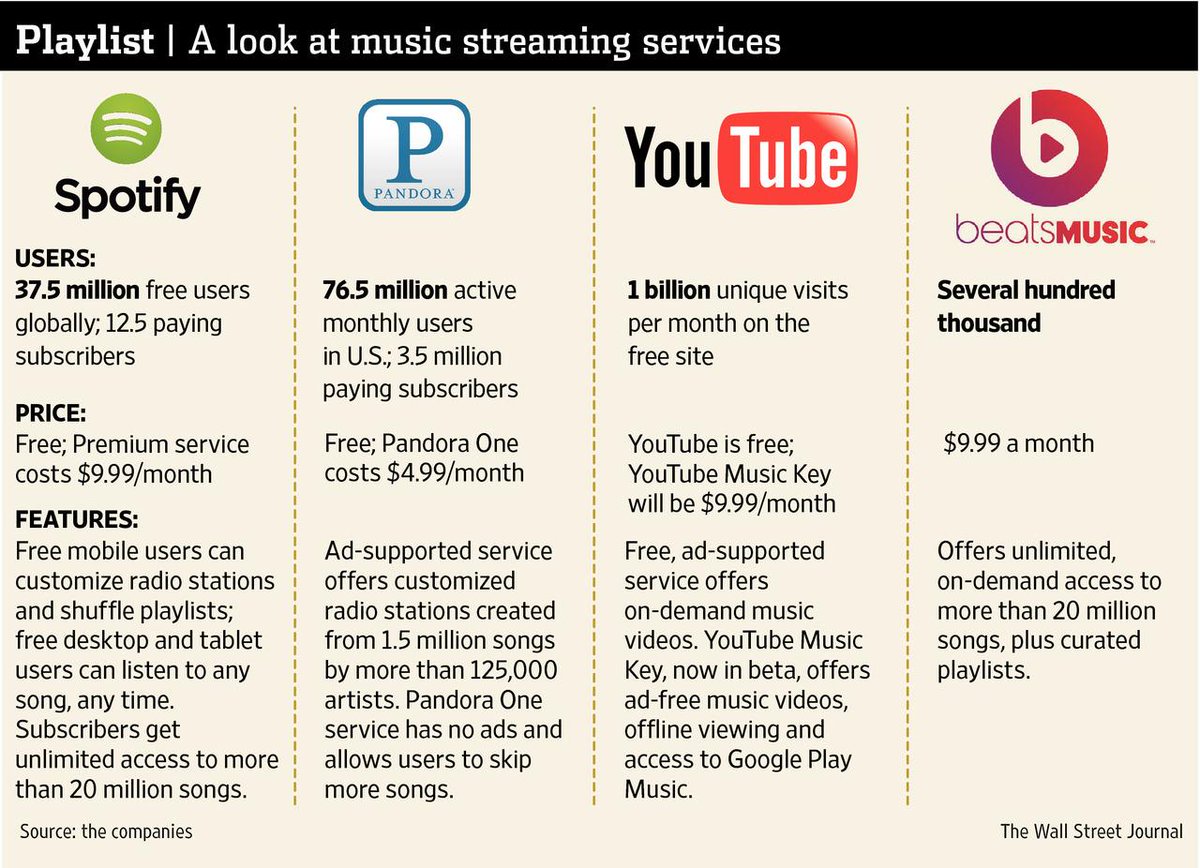
One small problem: customers aren’t interested. The WSJ shows the stats for streaming music
  • Spotify (global) 12.5m paid, 25m unpaid
  • Pandora (US) 3.5m paid, 73m unpaid
  • Beats Music (US) < 0.5m paid
In other words, there are about 6 freeloaders for every paid customer. Google’s new YouTube Music Key (at $10/month) will increase the number of paid users, but probably not appreciably change the ratio. Meanwhile, the services say claim that if they lose the ability to provide a 30 day free trial, they won’t get new paying subscribers.

There does appear to be one royalty that is doing well: the elite entertainers. The article reports Taylor Swift asked Spotify to limit her new album (1989) to the paid service, but the company refused. So instead, Swift pulled her album from Spotify and sold 1.7 million copies in its first two weeks — half of those as physical CDs — and perhaps the only album that will be RIAA platinum this year.

Similarly, Garth Brooks (3rd in US record sales after the Beatles and Elvis) created a new download service called GhostTunes — to host his own latest album. (It also has music by Swift, Pink Floyd and the Foo Fighters). The many zombie bands from the 60s and 70s also seem to be able to generate sales — perhaps from price-insensitive geriatric baby boomers — that insulate them from the pressures of the current market.

So — as my class used to conclude 12 years ago — the ability to set your prices without fear of competition is something every firm aspires to. (PayPal alum Peter Thiel has been saying the same thing recently in his new book, Zero to One). The problem is, there’s no way that Hollywood will ever get their monopoly pricing power back — any more than Luke Skywalker will get back his hand, his dad and his innocence, or that the original Beatles will be finally reunited in the flesh.

Tuesday, August 19, 2014

Google Show Greed Trumps Values Every Day

Google once promised that is mission was “to organize the world’s information”. Nominally that remains its mission today.

On the 10th anniversary of its IPO, in this morning's WSJ, Rolfe Winkler shows how that all changed:

Just before Google Inc. went public 10 years ago, co-founder Larry Page said he wanted to get the search engine's users "out of Google and to the right place as fast as possible."

Today, Mr. Page's Google often is doing the opposite: Providing as much information as possible to keep users in Google's virtual universe.
At first, leveraging its dominant share in search, Google was content to have people linger longer (ala Yahoo or later Facebook) to sell them to more advertisers. Now they want to monetize that customer hold directly by doing transactions and taking a piece of the action. The dead tree (and online edition) shows the before and after — Google the indexer of the Internet vs. Google the horizontally diversified Internet portal:

In other words, Google once created an ecosystem (including APIs and a two-sided advertising market) and wanted to make its ecosystem partners successful. Now, in its relentless pursuit of growth, it is crowding aside its onetime partners and trying to take more money from its customers.

This is exactly what DEC, Apple, Microsoft, Oracle and countless other tech companies have done over the decades. Joining an ecosystem is a viable startup business until the ecosystem sponsor wants to take that business away. The book Keystone Advantage refers to this as an ecosystem “dominator.” Among tech companies, only IBM seems to be a reliable partner for win-win alliances, in part because its integration services business model allows it to make money with almost any sort of component.

Of course, this was inevitable. Companies like Google want to grow, because it supports the stock price and puts more money into the hands of shareholders, employees and executives. Since Larry Page and Sergey Brin are now worth $32 billion apiece, I’m guessing it’s less about the money and more about the control, the ego, the success of making the world’s most dominant influential company of all time.

As we teach in strategy, there’s only two ways to grow: reach more customers or make more money out of your existing customers. If Google is serving almost everyone on the Internet, it either has to connect more people to the Internet (who will be less profitable than their existing customers) or sell more stuff to those already locked into Google. Obviously (with its $50 billion in cash horde and 60+% gross margins) it’s doing all of these things.

Unfortunately, a dominant vertically integrated (and horizontally diversified) monoculture is bad for the economy, bad for consumers and bad for society. It takes transactions that should be happening in the market and internalizes them into an internal hierarchy. Europe has been trying to nibble at the edges of Google’s efforts at Total World Domination for years, but had little impact. The U.S. seems disinterested, because the GOP believes in free markets and the Democrats receive millions in campaign donations from Google's wealth.

Normally we can count on the curse of success to eventually kick in: big companies either become complacent, bureaucratic or otherwise lose their way (cf. GM, Microsoft). The Google founders seem determined to make sure this doesn’t happen during their lifetime, which could be 30 years (with a normal retirement) or 50 (if they last like Warren Buffett). Since I’m older than both men, I may not live to see the end game — which is a depressing thought.