Showing posts with label K-12. Show all posts

Thursday, June 16, 2011

Accountability in K-12

A local K-12 charter school is proposing to expand its footprint in Santa Clara County with another 20 schools in the next seven years.

Rocketship Education has achieved impressive results (a state API of 925 in one elementary school) by doing something we take for granted in private industry but is never talked about in education: improving labor productivity. The school uses technology to automate rote learning, and then applies the savings to hire better teachers and give them more time to work with students.

In addition to its unprecedented business model, Rocketship also proposes unprecedented accountability — agreeing to surrender charter licenses if its API falls below 775.

The liberal Mercury News was gushing in their editorial endorsement Wednesday of the company’s proposed plans. And on Wednesday night, parents spoke in support of its proposal while school districts argued for business as usual:

In an emotional public hearing that contrasted different approaches to school reform, the Santa Clara County Board of Education on Wednesday heard heartfelt pleas for more high-achieving charter schools serving poor children, while local superintendents cautioned against moving too fast.

"Parents across Santa Clara County deserve more options," said parent Kevin Ngo, noting that his daughter's kindergarten year in the charter school Rocketship Los Sueños "exceeded our expectations."

He and several others spoke to support an application by Rocketship Education to open 20 charter elementary schools by 2017 near the worst-performing schools in Santa Clara County. It's an ambitious proposal that could make the charter operator the fourth-largest school district in the county. Palo Alto-based Rocketship aims to eliminate the achievement gap, the gulf between the highest-and lowest- achieving students.
Meanwhile, school districts and teacher union oppose the proposed expansion — presumably because they care more about losing resources to competing schools rather than improving education outcomes for local kids.

The final vote is due Aug. 10 on the plan to open new schools starting in 2013.

Wednesday, June 1, 2011

Fixing K-12: technology is no silver bullet

Three items from the San Jose Mercury News this week offer competing theories of K-12 education reform:

A local news story Sunday (May 30):

U.S. should look abroad for education reform, study says
By Sharon Noguchi

By the thousands, U.S. public schools have undergone overhauls, launched pilot projects and experimented with "best practices." Yet despite countless reforms, overall student achievement has stagnated for about 10 years, according to national and international measurements.

Instead, the report from the Washington, D.C.-based think tank recommends emulating foreign success stories, primarily by expanding national standards for curriculum, administering smarter and less frequent testing, improving teacher quality, salaries and authority.

The report suggests expanding on the "common core" standards in math and English that most states adopted last year. In the five exemplary countries, national curricula also cover science, social sciences, arts, music and often religion, morals or philosophy.
A column Sunday by one of the Merc’s business columnists:
Building schools for the 21st century will take courage
By Mike Cassidy
Mercury News Columnist

I spent a good part of last weekend closed in a hotel conference room listening to smart people talk about kids, schools and technology.

And a strange thing happened: I started feeling better about the future of public education in California.

Moving our country's public schools back into the upper echelon of rankings worldwide is going to take courage. This is no time to be afraid of the dark side of digital media and the Internet. Quit fretting over digital distractions and the specter of online stalkers. Stop obsessing about completely controlling your kids' media diets. … And push your kids' schools to do the same.

Some middle and high schools are already out there. There are schools, yes public schools, where each kid has a laptop. Schools that have social networks on which students collaborate. Schools in which the kids write the rules for proper use of technology. Schools where students and teachers use smartphones to analyze scientific data. Schools that rely on computer games that send students on quests requiring the mastery of scientific and mathematical principles.
A letter to the editor Wednesday (June 1) by a “Professor of Innovation & Entrepreneurship” (and K-12 education activist):
Letters to the editor
True reform needed: Teach writing skills

In two stories May 29 about K-12 education reform, one need was conspicuously absent: teaching students how to write. I get college seniors who received social promotions from local high schools (and middle schools and elementary schools) but never mastered basic writing skills.

It's not sexy: it doesn't involve tablets or texting or social networks, nor does it show up in the multiple-choice benchmarks comparing the United States to other developed countries.

Instead, it requires a meticulous, labor-intensive process to teach kids how to express an idea, to organize it into coherent sentences, paragraphs and essays, and to do so without grammatical errors. By doing so, the students also learn logical thinking and how to support an argument -- crucial skills for any career.

Joel West
Professor San Jose State
In response to the letter, I  got an email from a professor in another SJSU college who had similar problems:
I am shocked and dismayed that so many of our students at SJSU not only have atrocious writing skills, but that they receive such high grades in courses that require them to write. I have given students Ds and Fs on term papers only to discover the same student received an A or B in [the required writing class] or another lower division class. 
It doesn’t take a college degree to figure out which theory I find most convincing — after the past nine years of teaching an essay-based course for college seniors at a Silicon Valley public university. As the strategy faculty have argued for years, a major reason our students arrive at SJSU unable to write is because they are unable to think. We try to make things better, but aren’t always successful.

Update Wednesday 9:30pm: I also got an email from Helene Joseph-Weil, retired music professor from Fresno State. Here are excerpts from her own experience:
No matter how talented or brilliant a student may be, if he/she can't construct a sentence with proper syntax and punctuation, professional or academic brilliance can never be fully realized. 

In the past few years, I've truly despaired that the majority of my students at Fresno State cannot construct a sentence that has the subject and verb in agreement; their spelling is not up to standard usage, they confuse parts of speech [there vs. their, it's vs its, you're vs. your, etc.]; topics for papers are not presented according to clearly defined guidelines; and there is a marked inability to express their ideas in well-constructed, coherent sentences.… They demonstrate good ideas, even creative research, but seem to have a complete lack of ability to express either.

Every once in a while I will have the joy of a student in my studio who has good writing skills, but almost all of these are home-schooled or come from families whose parents are teachers or doctors. Strong writing skills  shouldn't be the exception, but the norm for entry level university students, and the current valuing of technological and scientific skills over the humanities must be combined with the ability to express the very ideas gleaned from such studies.
and the Merc is running this letter Thursday in response:
Letters to the editor
Practicing what he preaches


Bravo to professor Joel West of San Jose State (Letters, June 1) for his letter about the importance of teaching basic writing skills in grades K-12. The message is right on, and his clear, precise letter is a perfect example of the skills he advocates.

Dave Stein
Mountain View

Wednesday, February 9, 2011

Girls: stick to it!

As happens every year around this time, I returned to my daughter’s (now former) elementary school tonight to help with the science fair. When it was founded seven years ago it had less than 30 project, but this year it drew almost one third of the school with 150 projects — so big that they had to split it across two days. Tuesday was K-2 and Wednesday was 3-5.

After running the fair for three years, this year I just had to show up and lead a team of 11 volunteers to judge 26 3rd grade projects. As always, it was very gratifying to help these young kids out.

After all the prizes were handed out and all the pictures were taken, I was gobsmacked by the pattern: all the first place winners were girls. This was not a coincidence.

We hear* how girls don’t stand a chance in math/science/engineering education and careers. Programs like Girls Go Tech (the girl scouts) and Dare 2B Digital try to reach them in K-12 while the Anita Borg Institute and Society for Women Engineers try to support them once they’re grown ups.

And yet, here in the extreme southern suburbs of Silicon Valley, it’s girls winning the elementary school science fair. At my daughter’s middle school, girls are disproportionately represented in the most advanced math track.

At this age, girls have an advantage: they are more serious students, less fidgety, more compliant and likely to study. As judges, we saw the effect of these two factors, plus one more: they are more social and better at ease talking to people, which means they are more convincing when they explain what they did in the science fair project.

Sociability and communication skills are important for bench scientists or engineers, but not necessarily the most important skills. They are crucial for managers, sales and marketing types. So if Silicon Valley, California and the US are going to incubate more successful technology-based firms, we need these girls to stick to it and enter the tech company workforce.

In my own case, my middle schooler is debating between becoming an elementary school teacher (little kids are so cute) and an engineer. (She won’t be following her dad into computers: “Programming is boring: I liked the finished product, but that’s about it. I like making things.”) It will be a decade before we know for sure which one will win out.

* Actually, according to NSF statistics, women accounted for 50.5% of US undergraduate science and engineering degrees in 2006 , up from 39% two decades earlier. They are the majority in life sciences, social sciences and psychology. (Quelle surprise!) They are also a healthy 41-42% in physical sciences and earth sciences. The only areas where they are low are math/computer science (26.8%) and engineering (19.5%)

Photo of the 5th grade winner of the 2011 Simonds Science Fair courtesy of Nicole van der Hulst.

Wednesday, May 12, 2010

Scientists of the Future! Thursday Only!

This week, the annual Intel International Science and Engineering Fair is at the San Jose Convention Center. The fair brings 1,500 high school students from 53 countries who compete for $4 million in awards and prizes.

The fair is open (free) to the public on Thursday 9am-9pm, with student contestants present at their projects from 10am-2pm.

I spent Tuesday night and Wednesday morning judging science fair projects, as one of 100s of special judges (not counting 1000+ regular judges). Although I have judged county science fairs for the past 22 years, I found the projects really fascinating.

In the best projects, the students were completing what could be a senior (undergraduate) thesis, or even a master's thesis. Even for the ones that don’t reach that level, the sorts of problems they choose — and the solutions they found — are stimulating in a way that you can’t get by looking only a products that make it to market.

The fair is run by Science for Society and the Public (a DC nonprofit) with named sponsor funding by Intel as part of its (admirable) education initiatives. However, Intel was almost invisible: beyond some Intel T-shirts it otherwise lacked an obvious presence.

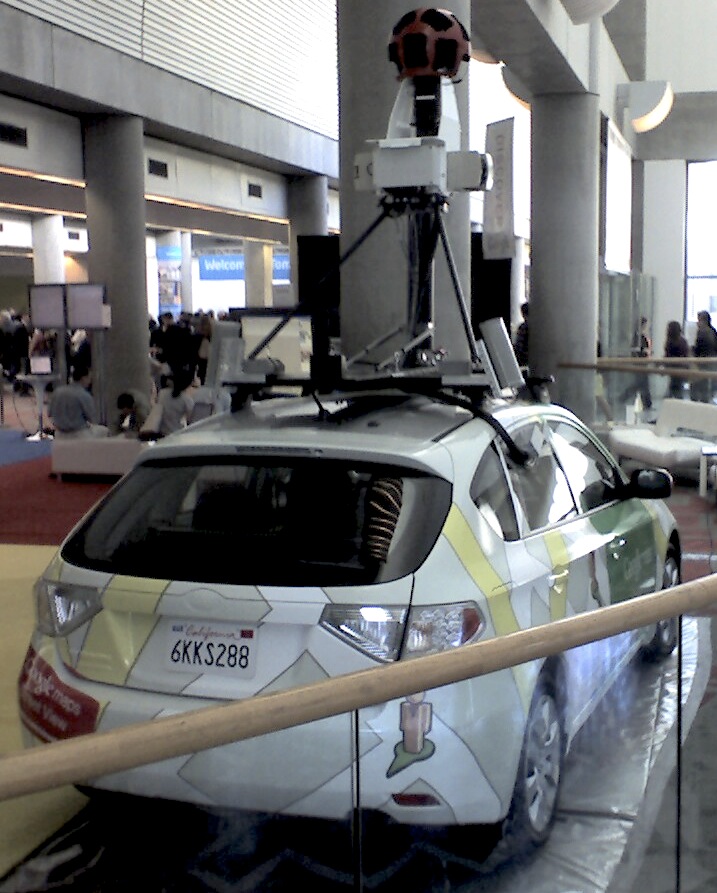
Instead, the company that was most prominent was the “premium sponsor", i.e Google. It was showing one of their (once top-secret) Street View cars at the center of its booth, as well as peddling various software (Apps, SketchUp) and SaaS offerings.

Overall, Google’s presence suggested a calculated effort to convince these smart kids that working at Google is the ne plus ultra. Was Intel absent because it’s not hiring? Because it no longer has the slack resources to be actively involved? Or because it was outmaneuvered by Google?

The awards are handled out Thursday and Friday, and then the kids fly home. Next year, Los Angeles will host the fair, as part of a three year rotation with Phoenix and Pittsburgh.

Wednesday, March 17, 2010

Future scientists and the future of science

One of the hats that I wear outside of my job is as a STEM volunteer and (cringe) activist. Unlike Stem Cells, it’s not a very controversial position, but it does require overcoming huge amounts of inertia.

STEM is the (fairly recent) TLA given for K-12 education in Science, Technology, Engineering and Math. The idea is that certain professions (and thus society) will be in trouble if we don’t give our children the basics, keep them interested through adolescence, and expose them to real science and the career opportunities. The NSF, Department of Education and others are making (limited) efforts to correct the problem.

As with last year (and most years since 1989), today I spent the whole day (as I have annually since 1989) as a judge for the county science fair, now known as the Synopsys Challenge after its sponsor. As an IEEE member, I was part of a team of a dozen or so judges that gave out awards on behalf of IEEE and other organizations that outsource their judging to use (due to our superior processes and scale efficiencies).

Among the junior/senior high projects I saw, perhaps the most exciting was an improved efficiency wind turbine blade where the 12th grader applied for a provisional patent earlier this year. (I also suggested a provisional patent for two Cupertino students, although they are probably more than a year away from a prototype that would justify the cost of a full patent application.)

Mostly I looked at computer science or computer engineering projects, including three by 11th grade boys. One Palo Alto student measured the robustness of the SVD algorithm at the heart of the winners of the $1M Netflix challenge. A San Jose student improved on encryption strength using a different randomization technique, and solving the indeterminacy of the decryption problem. A project from Cupertino looked at solving differential equations using Nvidia’s CUDA GPU toolkit. A fourth project introduced me to DNA computing.

Today marked the 50th anniversary of the Santa Clara science fair, which is 5 years younger than the San Diego science fair where I was once a contestant and later a judge. An interest in science fairs is a theme of my K-12 efforts, having run the science fair at my child’s elementary school for 3 years.

I also try to recruit volunteer science fair and robotics judges from among MIT’s 10,000+ alumni in Northern California as the coordinator of the MITCNC K-12 outreach efforts. My next task is to help find Silicon Valley judges for the International Science & Engineering Fair to be held in San Jose May 11-14. (Apparently some of our outreach efforts are a model for a nationwide K-12 outreach effort being launched nationally by the MIT Alumni Association).

The extracurricular stuff is fun, and recognizes the best and the best of the best. But it does little to raise the understanding of science and technology by the average college student, employee or citizen — or to increase the supply of graduates for STEM-related professions.

Last week, I went to the semi-annual regional meeting of SJSU’s Center For STEM Education, to meet local K-12 STEM educators and administrators. What I heard was troubling.

The weakness of STEM education is particularly severe in grades K-5, where one estimate is that California kids get 1 hour/week of science education. There are several root causes. While secondary ed (grades 6-12) has science (“single subject”) specialists, K-5 teachers are generalists — most with a humanities background.

Worse yet, some California principals don’t care about science achievement because it plays a very small part in the standardized performance tests — by one estimate, 5% of the school’s total points. This is an example of the tyranny of measurement — perhaps not so blatant as WorldCom sales commissions, but one that has a far broader and longer-lasting impact on society.

Last Saturday, President Obama announced his intention to fulfill promises to teacher unions to water down No Child Left Behind. But the one change that I would agree with is the idea that school districts could modify the weighting criteria to include subjects such as science.

The actual technical content of improving science education is pretty straightforward. The organizational change to make that happen in more than 15,000 districts across the country is quite daunting.

I’m not sure how to get from here to there, but apparently that’s not enough to discourage me or my fellow STEM activists from pursuing such a Sisyphean task. Perhaps efforts by other alumni organizations — and professional scientific and engineering societies — will help raise the priority and efficacy of K-12 science education.

Wednesday, March 4, 2009

Encouraging young scientists

Bill Gates and other captains of IT have been complaining for years about not enough science and engineering graduates of US universities. Their two-pronged solution has been to try to encourage more students to major in such subjects, and also to import the best and the brightest from the rest of the world.

One way that industry has been trying to encourage science and engineering careers since the early days of the Cold War has been through local science fairs. Here in Silicon Valley, students grade 7-12 (or 6-12) can enter their local school fair, then go on to the California State Fair, and even on to the International fair (once sponsored by nuclear reactor maker Westinghouse but now sponsored by Intel).

The science fair also has great sentimental value for me. My 8th and 9th grade science fair projects were the most meaningful educational experiences of my three years in junior high and perhaps all of K-12. The latter project — my first computer program, writing a parser in Fortran IV on a stack of IBM punch cards — would set the stage for the next 20 years of my career.

In 1989, I started as a volunteer judge for the San Diego fair that gave me that start, and switched to judging for the Silicon Valley fair when I moved up here. That one day commitment is an easy way for engineers to contribute back to the community to develop an interest by K-12 students in science. After mentioning that interest last fall at the MIT Club of Northern California, I became the club’s science fair coordinator, and prepared a web page listing fairs where our members can volunteer.

Five years ago, parents and one teacher launched a science fair at my daughter’s elementary school, in a community with a large population of IT engineers or (like me) former engineers who later went into management or marketing jobs. For the past three years, I’ve been running the judging and leading the committee that runs the overall fair. The last few days have been a blur as we tried to nail down which students and volunteers would be coming to the fair, and have everything ready for the contestants, judges and visitors.

Tonight was the culmination of all those efforts. We had 101 projects by 128 students, 30% bigger than last year and our biggest fair ever. Two years ago we were unable to fit in the school cafeteria and so had to move to the Almaden Community Center; tonight it looks like we may soon outgrow that.

We had 32 volunteer judges who spent 2-3 hours at the fair, talking to students and awarding prizes. Some but not all of them were local parents. In particular, we had 11 volunteer judges (mostly young engineers) from Lockheed Martin in Sunnyvale, and five judges from our local high school robotics team.

The event was bittersweet for me. It is a relief to have it over, as this is my biggest volunteer effort ever. On the other hand, this my last year running the fair as my daughter moves on to middle school (although I have offered to help judge next year). As in several previous jobs, I am working hard to document procedures so that my successor will have an easier job than I did.

Local technical professionals don’t have to start a fair to get involved. In fact, on March 18, the Santa Clara County fair for grades 6-12 is being held in San Jose and like other fairs they chronically need judges. For the MIT club, I’ve made a master list of all major fairs in California.

Those who judged last night and at various regional fairs say they find it a very rewarding experience, nurturing young scientific talent for our future.

Saturday, April 12, 2008

Prize winning (age appropriate) science

Although I have a backlog of topics, my blogging this week has been deferred as I led a group of volunteers to put on the science fair at our local elementary school. I was on the committee that created the science fair four years ago, was co-chair last year and (titular) sole chairman this year (although the committee of four spread the work pretty evenly).

As with last year, my main role was coordinating judging. This year we had 27 judges evaluating 71 projects by 97 5-11 year-olds. We didn’t have science fairs when I was in elementary school, but in junior high school I participated in the Greater San Diego science fair and even won the jr. high math category twice — the second time (1972) with what I think was the first-ever winning computer project at the GSDSEF.

I started judging in 1989 at the regional championships for middle school and high school students, and I have judged almost every year since — first in San Diego, now in Silicon Valley. My only concession to burnout is that three years ago I switched over to judging for the local IEEE chapter, in part to try to become more integrated as an IEEE member. I find the professional society judging to be less stressful and also more fun, particularly when I get to be a judge for SWE (no, not dressed like Jack Lemmon), but I’d switch back to category or sweepstakes judging tomorrow if they needed it.

I’ve roped a number of my science-oriented friends into judging, and to a man (or woman or teen) they all seem to enjoy it. Working with motivated kids is fun, and I’m sure many of them also see themselves at that age (I know I do). It’s also a public service: even though the Cold War (that spawned the SD and other fairs*) is over, the perceived need for the US to grow a supply of scientists and engineers remains. Improving K-12 science education is a part of any such plan.

(*Interestingly, while the regional San Diego fair was started in 1955 at the height of the Cold War, the national fair — the Westinghouse now Intel Science Talent Search — was started in 1942 during World War II).

With ties and team projects, we handed out 17 ribbons last night to 11 projects in 3rd, 4th and 5th grades. The best 3rd grade project ran a doorbell using a lemon battery, while the 4th grade project built and calibrated a thermometer. I didn’t see the 5th grade projects, but both were in life sciences — one extracting DNA from strawberries, the other measuring the effects of disinfectants on bacteria.

What was also interesting was that half of our six-girl prize-winning robotics team entered the fair, and all three won prizes. One of those winners was my daughter (and her robotics teammate). While I was proud of their success, it was a little embarrassing because only the judges knew that we assigned judges so that no parent knew how their kid did until the results were announced. (As you might imagine, there was a considerable overlap between volunteer judges and parents of contestants).


However, I think the program is also a testimony to public schools at their best — highly involved and educated parents who want their kids to succeed. As in companies, a culture of inquiry and achievement is important for elementary schools. Unlike many places I have visited in the East and the South, we are fortunate that many successful Californians send their kids to public schools and then pour their energies into making those schools successful.

Photo of prize-winning thermometer construction taken by Oliver Huang.

Sunday, January 13, 2008

Even prouder papa

Saturday was the end of the FLL robotics season for the Technology Cougar Chicks of Simonds Elementary School, as we spent all day at the Northern California Championship of the First Lego League.

TCC was one of 14 teams to advance from an earlier preliminary tournament. The 64 teams represented the best of 282 teams in Northern California from San Jose to Chico. The teams were judged on four criteria: robot performance, robot design, teamwork and presentation of an energy conservation research project.

Winning the robot performance was never in the cards, with four teams achieving perfect scores of 400. However, TCC raised robot score from 310 to 355 in five weeks. Our girls were disappointed not to get the 380 points we saw in practice Friday night, but finished 13th overall. This appeared to be the highest point total of any girl’s team and one of the top (if not) the top score for an elementary school team.

However, we were all stunned when the girls were recognized as best “Rookie Team” out of 16 participating in the championship. This was the only trophy they had a chance to win, and reflected not only their robot performance, but their poise, understanding and hard work in 30 meetings since July 8. Quite an achievement for six fourth- and fifth-grade girls who a year ago didn’t know that Lego makes robots.

Members of the 2007-2008 Technology Cougar Chicks. Left to right with their trophy: Connie, Sonya, Nicole, Katy, Anjali. Not shown: Sahana.

Being interviewed by a reporter from the Almaden Resident, I had to articulate the benefits of FLL. At a young age, kids learn computer science and mechanical engineering. More importantly, they learn about teamwork, stick-to-itedness and the crucial engineering principle that “stuff happens.”

In turn, I learned a lot about kids, K-12 education, and even technology policy from the exercise. There’s no government money in this activity, except for a few schools that get the equipment donated from their principal or PTA. As with Little League, the teams are run by parents, and the tournaments wouldn’t happen without referees, judges and other volunteers. (Google and the SIA were sponsors of the championship). Our team was greatly helped by volunteers from Leland High School’s robotics club: Natalie, Beeta and Jenny.

Yes, it would be nice if this opportunity were more widely available, but it’s certainly an important start. FLL (for 9-14 year olds) is completing its 10th year, and is a low-cost offshoot of the high school age FIRST Robotics Challenge. FIRST in turn was founded in 1989 by Dean Kamen, a serial entrepreneur and inventor of the Segway. These, in turn, are derivatives of MIT’s famous (and influential) design course 2.70 (now 2.007) that began nearly 40 years ago.

Finally, I learned something about myself. Nine months ago, I asked parents if they wanted to launch a robotics program at Simonds. The result was 21 kids on four teams, including six girls ages 9-11 (and three coaches) on TCC.

So far I’ve helped start one company, two trade associations, a computer club, a school science fair and a local Internet initiative. Social entrepreneurship can be as exhilarating as the for-profit equivalent, as is the satisfaction of building something from nothing. I can see why those who no longer have to worry about paying the bills find it very rewarding.