Showing posts with label brands. Show all posts

Wednesday, April 22, 2015

Target's Pulitzer-losing strategy

The success of Target over the past two decades has been built by offering better quality merchandise at lower prices, creating a unique position (and loyal following) between traditional discounters and higher-end retailers. As with other discount retailers, Target has partnered with higher end brands, providing volume in exchange for their cachet.

The latest effort was Sunday, when Target offered an exclusive collection from Lilly Pulitzer, a line of colorful women’s clothing originally based in South Florida. My teen tells me this is the brand of sorority girls and other Southern Belles. The line is normally sold in expensive boutiques, and thus Target provided both convenient distribution and the promise of better prices.

However, the demand vastly exceeded Target's expectations. As with healthcare, the initial focus was on the crashing. However, as it turns out, the more systemic problem occurred in the retail stores.

At the two stores nearest to our home, the clothing sold out in the first hour, with cosmetics and accessories lasting about a day — a pattern repeated around the country. It was a one-time deal, with no restocking planned. Target later admitted that it expected that the sales (and traffic) would last weeks and not hours.


Instead, enterprising shoppers cleaned out the stores — one shopping cart at a time — to resell the products upon eBay. By our count, there are 38,000+ “Lilly Pulitzer for Target” products on eBay at 3x the original price. Lilly’s fans have vowed to boycott the online sales with their own hashtag (#LillyforeBay).

Avoiding this problem isn't rocket science. Our generation knows this as the Rolling Stones (or Springsteen) concert ticket problem — limit 2 per customer. The former newsmagazine Newsweek reports that H&M imposes limits on similar promotions.

Per Fortune, Target claims that only 1.5% of the merchandise is being resold, but I suspect that includes the less desirable accessories. The fashionistas denied even a single copy of the iconic Lilly Pulitzer shift dress — despite being there when the doors opened at 8 — would consider the problem more serious than Target wants us to believe.

The Pulitzer fiasco has certainly undercut Tarzhay’s image of chic fashion and operational efficiency. And apparently this happened four years ago when Target sold the Missoni designer brand. A brand is a shortcut for quality — including reliability and predictability – which is the opposite of what this weekend’s shoppers experienced.

If they were targeting boomer geezers it wouldn’t be a big deal, but irritating the pre-teens and teens that are its future customers is equivalent to pissing in the soup. It’s a perfect plan to send these young shoppers back to mall for H&M and other specialty realtors.

So — as in so many other aspects of business — here is another example where the execution is more important than the strategy.

Tuesday, January 28, 2014

When the brand trumps the product

In strategy, we often debate the cause and effect of success: how much is the product, and how much is the perception of the product? Fortune 500 companies spend billions trying to build the brand, in hopes that builds loyalty beyond (or instead) of anything the product does.

This question has come up in higher education, but I’ve never hear the brand value put so starkly as in this FT article this morning:

“A degree has value only if the degree is scarce, and the MBA is completely unscarce,” says Jeffrey Pfeffer, professor of organizational behavior at Stanford Graduate School of Business.

Prof Pfeffer has published on a wide range of topics but is well known for taking on the industry in which he works – business education. He argues that schools’ reputations have suffered from promoting themselves as a route to enhanced future salaries. The professor has been pointing out for a decade that the value of a degree is linked to the prestige of an institution rather than what it teaches – but few people have been listening.

“People don’t hear what they don’t want to hear,” he says, adding that he nonetheless believes that unless you go to an elite school – by which he means one ranked in the top 15 worldwide – an MBA is a complete waste of money.
So, Prof. Pfeffer’s argument goes, the value of the MBA is the transfer of the elite brand to your resume.

My coauthor, fellow blogger, former Apple and Palm executive and entrepreneur Michael Mace listed the bundle of services in a degree:
universities bundle several services in that thing called a degree:
--Teaching the students
--Credentialing (ensuring that the students have learned the material)
--Giving the students social connections (Yale, Stanford)
--Helping young people turn into adults in a semi-safe setting
The latter was on Mike’s mind as the parent of an undergraduate (now two), but the other three certainly apply to MBA programs.

By Pfeffer’s theory (or conjecture), the value of Stanford MBA is the credential, not the actual content of the courses. This is consistent with what other academics have wondered — are Stanford MBA students successful because of the selective admissions, i.e. is all the value of the MBA added by the admissions office letter?

In fact, in the FT article a soured MBA graduate recommend just that. Author of The MBA Bubble, Mariana Zanetti told the FT:
“But I don’t think it’s the MBA that adds the value – it’s the selection process that makes the difference,” she says. She would even recommend getting a place at a top school and turning it down to prove you were of a high calibre without wasting money.
Even if Pfeffer is correct, he leaves out a crucial factor in calculating the net value-added: cost, both out of pocket and opportunity cost.

Some MBA programs are more expensive than others. Obviously for the same cost-benefit, a low cost doesn’t have to deliver as much benefit. Forbes calculates the ROI on Stanford, which has the second highest prices (after Harvard). The public schools on the normal top 25 lists are charging market prices, but the Forbes list identifies some state schools (like Iowa, Michigan State or Washington) that gouge their students less than others.

The second cost is the opportunity cost. No one would argue that Bill Gates or Mark Zuckerberg would have been more successful if they had finished Harvard. During the dot-com mania, Stanford and Harvard MBA students were dropping out to start companies — both learning on the job (in a way new graduates rarely do) and getting lottery tickets (stock options) that could allow them to retire before 30.

Whether or not the (self-serving) observations of elite b-school professors are correct, the question of the value added by education is one that needs to be addressed. However, students who don’t get an elite credential might get other value from they bundle of services, i.e. if they actually learn something in college or grad school. To me, the acid test is what middle-aged students do with their own money: their careers are determined by their prior experience, not any burnishing of their resume by a mid-career degree. Instead, they go to school to improve their own human capital. These students are a breath of fresh air for any teacher.

And overall, I think Pfeffer’s analysis (true or not) sets a terrible example for his students. It’s a serious mistake for any business — including a nonprofit — to focus strictly on the brand and forget about the quality of the product. Even Apple — held out as a master of PR and branding — was left for dead in the 1990s due to its product execution, and only came back (and once again changed the world) because it made stuff people wanted to buy.

Friday, November 16, 2012

Ding dong, Hostess is dead

Perhaps the big news of the day is that Hostess Brands is closing its doors after 82 years. Hostess has been attempting a reorganization since its January filing for Chapter 11 bankruptcy, but after a weeklong union strike Hostess said Friday it asked for court permission to close its doors and will lay off most of its 18,500 workers.

The TV news was filed with consumers rushing to buy up what's left of Twinkies and Ding Dongs, some of them hoping to make a quick buck on eBay.

My teenager was sorry to see Twinkies disappear and argued that we should stock up on the sponge cake — because they would store well at least until I'm a grandfather. (Wikipedia says this is an urban legend that may be attributed to a brief Twinkie cameo in the movie WALL-E although the Clinton White House put one in a 100 year time capsule.)

But even the consumers interviewed on TV realize that the brands will be sold to another company. Bloomberg identified at least two possible bidders, Flower Foods and the private equity firm than owns Pabst Brewing.

What went wrong? An Aug. 13 story in Fortune magazine said there’s enough blame to go around, with a mismanaged company, falling demand and high debt since an earlier 2004 bankruptcy filing

But in truth there are no black hats or white knights in this tale. It's about shades of gray, where obstinacy, miscalculation, and lousy luck connived to create corporate catastrophe. Almost none of the parties involved would speak on the record. Still, it's clear from court documents and background interviews with a range of sources that practically nobody involved can shoot straight: The Teamsters remain stuck in a time warp, unwilling to sufficiently adapt in a competitive marketplace. The PE[private equity] firm failed to turn Hostess around after taking it over. The hedges can't see beyond their internal rates of return. Et cetera, et cetera, et cetera.

The critical issue in the bankruptcy is legacy pensions. Hostess has roughly $2 billion in unfunded pension liabilities to its various unions' workers -- the Teamsters but also the Bakery, Confectionery, Tobacco Workers and Grain Millers International Union (which has largely chosen not to contest what Hostess wants to do -- that is, to get out of much of that obligation). If the bankruptcy court lets Hostess off the pension hook -- which often happens in these cases -- it only moves the struggle outside the courthouse, and the ante goes up. For the Teamsters can then call a strike -- which its Hostess employees have already ratified by a 9-to-1 margin.
Hostess settled in September with the Teamsters but not with the Bakery, Confectionery, Tobacco Workers and Grain Millers International Union, who called the fatal strike. The NY Times reported that union decided to play hardball:
Frank Hurt, the union’s president, seemed to lose patience with Hostess’s management, upset that it was in bankruptcy for the second time despite $100 million in labor concessions. He saw little promise that management would turn things around.

“Our members decided they were not going to take any more abuse from a company they have given so much to for so many years,” said Mr. Hurt. “They decided that they were not going to agree to another round of outrageous wage and benefit cuts and give up their pension only to see yet another management team fail and Wall Street vulture capitalists and ‘restructuring specialists’ walk away with untold millions of dollars.”

About a month ago, [CEO Greg] Rayburn said, the bakers union stopped returning the company’s phone calls altogether.
The union workers are gambling they’ll get their jobs back at the same factories under a new owner, but instead the failure looks like the classic lose-lose proposition. It’s clear that they won’t be getting defined benefit pensions or the same salary levels under the new owners, and it’s hard to see how all 18,500 will get their jobs from a new owner seeking to buy only the most profitable assets and to dramatically cut costs.

I think there’s more than just the pressure on high-wage, semi-skilled labor and the public health war on excess sugar. Society has moved to (as Geoff Moore put it) more fractalization of consumer demand, with increasingly specialized products reaching a broad range of tastes. A teenager who might have eaten a Twinkie every day now eats ones once or twice a week, with pretzels, a Larabar or Trader Joe’s fruit wrap the other days. Meanwhile, the Hostess donuts face increased competition from branded donuts, generic store donuts, chain donut stores and a proliferation of bagels everywhere.

Fame is not fortune — in part because the brand is the butt of nonstop jokes (including a tongue-in-cheek TV tribute by longterm union supporter and junk food addict Bob Beckel.) In some ways, the Twinkie (and other aspects of the) brand has become like “spam” — high brand recognition but not high brand equity. Oldtimers even remember the infamous “twinkie defense”, in which Dan White got off with a five year prison term after killing two people (vaulting Diane Feinstein to fame).

So what is the brand worth? Given the company lost $341m on sales of $2.5b (for its last reported fiscal year) with accumulated debts of $800+m, it’s hard to see how the remaining brands will go for even $200m, and more likely much less. By comparison, Zynga is 7 years old, with its main line of business in trouble, lost $404m on sales of $1.1b last year — and still has a $1.7b market cap. (It also has no unions and a 71% gross margin, suggesting a potential upside if it can ever regain scale).

Even when they went into bankruptcy, troubled airlines had a reason for existence, marketable assets, market share and (thanks to frequent flyer programs) switching costs. Hostess has little to recommend it, other than nostalgia (which failed to save Pan Am, TWA, Mercury, Pontiac or Oldsmobile, among others).

Is it worth saving? Two CSU Fullerton professors offer their guidelines as to when brands are worth saving:
While we feel that most brands can be revived, some brands may just not be worth the effort. This is particularly true for brands that suffer from lack of relevant differentiation, low awareness, and a negative image. In such a case, it may be better to kill the brand, than to invest in it.


Tuesday, August 18, 2009

Can get some satisfaction

Prof. Claes Fornell and his American Customer Satisfaction Index have come out with new quarterly satisfaction rankings for a variety of industries, two of them IT-related.

Here are the rankings for search

  • Google: 86%
  • Yahoo: 77%
  • MSN: 75%
  • Ask: 74%
  • AOL: 70%
Prof. Fornell’s commentary:
Google has led among portals and search engines for seven of the last eight years and this edge in user satisfaction is reflected in Google's dominance of the search market. Measured by query volume, Google does 74% of all search business on the Internet, with Yahoo! a distant second with 17% and Microsoft’s new entrant Bing.com third with 7%. Bing has won early accolades among industry insiders, but even a recent collaboration by the two smaller rivals (Yahoo! Search is now powered by Bing) hasn't managed to put a dent in Google’s usage. Strong and stable customer satisfaction has also left Google’s share value more insulated than most companies.
Here are the rankings for personal computers
  • Apple: 84% (down 1.2%)
  • Dell: 75%
  • Compaq (HP): 74% (up 5.7%)
  • Gateway (Acer): 74% (up 2.8%)
  • HP (HP): 74% up 1.4%)
and Prof. Fornell’s commentary:
Customer satisfaction with PCs improved slightly after two years of decline, increasing 1.4% to an ACSI score of 75. Rising satisfaction among Windows-based machines drove the improvement. Dell was steady with an ACSI of 75, while Gateway improved 3% to 74. The aggregate of smaller manufacturers also improved 3% to 74. The HP division of Hewlett-Packard made a modest gain of 1% to 74, while the Compaq division surged 6%, also to a score of 74. The satisfaction of Apple PC customers retreated slightly (down 1% to 84), but the small decline has done nothing to hurt the large lead Apple has enjoyed for six straight years over the Windows-based PC manufacturers. In fact, Apple’s customer satisfaction lead is the second largest of any industry in ACSI—only Southwest Airlines' advantage over its closest rival is bigger.

…Despite the recession, Apple has posted strong financial results, with profits up 15% for the second quarter, and sales of Mac computers have increased, while competitors’ sales have shrunk.

As the recession has shifted demand for lower priced PCs, Hewlett-Packard has been rolling out less expensive Compaq laptops—consumers can now get a fully loaded Compaq notebook computer for less than $300. The emphasis on Compaq has driven up recent sales and HP's stock is up 20% since the beginning of 2009, more than double the market.
Surprise, surprise: success in the sale of commoditized Windows boxes has come from selling ever-cheaper commodity boxes. At the other extreme, Apple has more than 90% of revenues from computers priced over $1,000.

What I found surprising is that Fornell didn’t mentioned the role of Microsoft’s $300 million “I’m a PC” ad campaign (made on a Mac) in raising satisfaction of Windows machines across the board. The initial ads last fall emphasized “pride” in being part of the Windows clan, while this year the fetching actress Lauren De Long and her “laptop hunters” ad (recently revived by HP) have been brutally effective in identifying Apple’s price premium at a time in which buyers are pinching pennies.

The Windows brand revival story is a pretty clear one, particularly after they dropped the attempt to leverage Jerry Seinfeld’s popularity and got a little closer to their actual product attributes — cheap hardware, ubiquitous, lots of choice.

Friday, February 20, 2009

GM: don't slit your own throat!

GM is shedding its peripheral brands in hopes of focusing its resources on saving its core brands: Chevy, Buick, Cadillac and GMC.

It has cut Saab loose, and the Swedish car maker filed for bankruptcy this morning.

However, far more troubling is GM’s decision to spin off Saturn — in response to pressure from its Saturn dealers around the country. Reuters reports this afternoon:

GM said on Thursday it was working to spin off Saturn as a distribution company to source cars from other automakers and sell them through the brand's 420 U.S. showrooms.
This passage in Thursday's WSJ set off my alarm bells:
Some Saturn dealers now hope that instead of closing the brand, GM will spin it off as a separate company. A team of Saturn dealers is spending 60 days working with GM to evaluate the possibility. These dealers would sell vehicles under the Saturn brand made by other manufacturers, possibly from overseas.

"This is going to be somebody's low-cost entry to the world's largest car market," said David Fischer Sr., chairman and chief executive officer of Suburban Collection, which operates eight Saturn dealerships in Florida and Michigan.
The articles don’t say, but my guess is that the interested buyers would be low-cost producers from China or India.

If I could offer one word of advice to GM:

Don’t!

This is exactly like RCA in the 1950s. To gain a small amount of incremental income, it licensed its color TV patents to some small, obscure electronics companies in the Far East. The direct result (as recounted by the late Al Chandler) was that the Sony, Panasonic, Toshiba, JVC and other color TVs effectively put RCA out of business.

GM doesn’t have technology, but it does have distribution. It would be foolhardy to sell some of that distribution to enable additional entry (in the already crowded US market) by a low-cost maker of fuel efficient vehicles.

If GM goes ahead and sells the dealer network, that’s confirmation that it’s less interested in long-term business viability and more interested in scoring short-term political points with its new owners in Washington, DC.

Thursday, February 12, 2009

Mervyns may live again

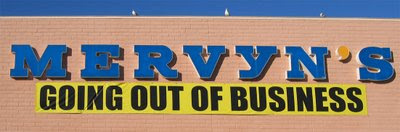
Mervynsexterior-28Dec2008Longtime clothing retailer Mervyn’s closed December 31. At a bankruptcy auction Tuesday, the various pieces of the carcass were auctioned off to the highest bidder.

The WSJ reported yesterday that the three sons of founder Mervin Morris bought the brand name and the Internet assets:

"It's great to have it back in our family after 31 years," said Mr. Morris, principal of Morris Management, a private-equity and real-estate investment company. "We strongly believe we have a very strong, loyal base of families in the Western states that would support Mervyn's."
Meanwhile, other firms purchased the rights to three of the company’s house brands: High Sierra, Hillard & Hanson and Ellemenno.

The report is sketchy and unfortunately there’s been no original reporting by local newspapers, just wire service and other accounts that paraphrase the WSJ report. Given that the chain was based in Hayward. This is exactly the sort of story that reporters would normally do a day two story on — and the original liquidation got plenty of ink locally.

The only other details come from an online story last night at the local CBS affiliate, KPIX Channel 5. Consumer reporter Ann Werner did some original reporting (a rare decision in TV, particularly in a business story):
"My dad built a fabulous chain of stores which was unfortunately mismanaged in the last few years. We wanted to get the family name back or his name back, see if we could create it again," said Mervin's son Jeff Morris.
Oddly, neither my wife nor I saw the story on the 11pm news.

The KPIX account implies that the reborn Mervyn’s may never come back as a brick and mortar store:
"I don't think you're going to see Mervyn's reincarnated in its original form. I think there will be a Mervyn's name on the horizon somewhere there, just how and when and what the magnitude will be I am not sure. That is going to depend on my boys," said Merv Morris.
With no stores and no house brands, I don’t know what the new Mervyn’s would offer those of us who lamented its passing. On other hand, no one could fault the Morris brothers for building slowly and prudently, only to the degree that they can bootstrap a viable and self-sustaining business.

Saturday, September 8, 2007

End to Detroit's versioning strategies?

While my own research is about open source, open standards and open innovation, once a year I’m reminded of other aspects of innovation strategies when I teach my MBA tech strategy class. As Thursday’s posting suggested, price discrimination (or versioning) as the sort practiced by Hal Varian is top of mind for a few weeks and then will be forgotten for another 50 weeks until I teach it again.

And so, flipping stations this morning en route to work, the idea of price discrimination was frontmost in my mind when a Fresno radio station show talked about the long sad decline of the Mercury car brand.

Established in 1938, Mercury (with dealers that also sell Lincolns) is one of the two Ford Motor divisions. The numbers they put up were stark: 450,000 cars/year in the early 1990s versus a projected 160,000/year in 2007. Most Mercury dealers sell something else.

The car talk guys (not the Car Talk guys) were reporting speculation that Mercury will eventually die, and debating whether Ford should do a phase-out (as GM did with Oldsmobile and Chrysler with Plymouth) — giving people a chance to shift their investments but also setting up several years of selling orphan cars — or maybe should just pull the plug quickly and move on. (Would this mean Lincolns move to Ford lots?)

But this calls to mind the good ol’ days when I was a kid, and Americans bought cars that were as American as apple pie and the red-white-and-blue (to quote a Chevy marketing campaign). Ford had Ford, Lincoln and Mercury; Chrysler had Dodge, Chrysler, and Plymouth (before they bought AMC which had bought Jeep); GM had Buick, Caddie, Chevy, Pontiac and Olds. (I think GMC came later as a 2nd brand for the Chevy trucks, and of course Saturn was a creature of the 80s).

Of course, the collapse of market share by the American companies (plus, as I was reminded this morning, the lengthening of the replacement cycle in the 1980s as cars got more reliable) means that GM and Ford aren’t selling as many cars and thus don’t need as many dealers and brands.

Still, what was the proposition?

  • Chevrolet: basic entry level car, nothing fancy (Corvette excepted)
  • Pontiac: performance, cars like the GTO (my neighbor’s treasured 60s muscle car) and the Firebird (a Chevy Camaro with sharper corners) and Trans Am ( think Knight Rider)
  • Oldsmobile: at one point a performance car (think Rocket 88) but later a slightly upscale sedan
  • Buick: a near-Cadillac for the middle class that can’t afford a Caddy
  • Cadillac: a word synonymous with luxury, the “Cadillac” of brands
Of course, after GM went for modular platforms and manufacturing efficiencies, the Buick and Olds became indistinguishable and the Olds was killed in 2004 a few months shy of its 107th birthday.

My dad favored Fords (although we had also owned at various times Rambler wagon, a Fiat 128 and a Chrysler 300). Of the Ford purchases, we had one Mercury Maquis, three1963 Lincolns, a 1972 Lincoln and then the rest Fords. As teenagers, my sister and I between us drove a Pinto wagon, a Pinto hatchback (the 4-wheel molotov cocktail) and a Mustang II. My wife & I have bought two Fords and a Mazda since we got married.

What was the difference between a Mercury and a Ford? I guess the word analogy is Buick is to Chevy as Merc is to Ford. But other than a different grille and a different set of dealers (the Ford dealer in Carlsbad used to be really really bad) there wasn’t and isn’t much difference between the two. Being small volume, Mercury tends to get products later than Ford, including the Mercury Mariner (a rebadged Ford Escape or Mazda Tribute) and the Mariner hybrid. (Mercury seems to be dying despite the able services of Jill Wagner.)

How could GM or Ford manage it differently? One way is the old Detroit way, of different drivetrains and perhaps even chassis for each product family. But apparently (given manufacturing or R&D scale economies) that’s no longer cost effective. On the other hand, the move to a common platform for GM (and Ford) saved costs but has eliminated differentiation for decades. Even loyal GM customers wonder if GM can make it with so many brands despite its impassioned defense.

Toyota seems to make it work, as a V-6 Camry has an MSRP of $24K vs. $34K for the comparable Lexus ES 350. I think the problem is that no one wants to pay a premium for a souped up Ford or Chevy. I think that’s as much a problem with the base product line (and its innovation, quality, reliability, fuel efficiency, etc.) as it is with the bells and whistles being added to the “premium” brands.

Tuesday, May 22, 2007

Jack is dead

Catching up on the blog while I am Sleepless in Switzerland.

[Cingular logo]Cingular is now officially dead. The mobile phone service was announced in 2000 as a 60/40 joint venture of SBC of San Antonio and Bell South of Atlanta. It instantly became the 2nd largest cell phone carrier, and plotted out a path away from the dead-end NADC (North American Digital Cellular, aka TDMA) over to GSM.

The murder was perpetrated by SBC which — after it bought AT&T and BellSouth — decided to rebrand it as AT&T. The rebranding effort announced on January 12 has now been accelerated.

AT&T Inc. today announced a new phase of the company's branding strategy. Overnight, AT&T kicked off this phase by replacing the Cingular brand with AT&T on all in-store signage, store kiosks, and point-of-sale materials in approximately 1,800 company-owned wireless retail stores. In addition, key stores in major markets also unveiled new exterior signage displaying the new brand.

The decision to move to this phase of the branding campaign is based on research that indicates that consumer awareness of AT&T — one of the best-known, most durable and iconic brands in the world — is high and ahead of expectations.

The store makeovers are also critical to prepare for the late-June launch of the Apple iPhone, for which AT&T will be the exclusive wireless provider in the United States.
The death of Cingular ties to AT&T’s grand ambitions to dominant the US convergence space:
Many company-owned stores have also installed kiosks promoting the complete array of AT&T services — wireless, high speed Internet, TV and home phone — in the company's traditional service area, and several markets are also planning for a new AT&T Experience StoreSM, a high-energy format that encourages hands-on customer interaction.
As the AP story notes, this is not without risk:
Jeff Kagan, a telecommunications industry analyst with Mindspring Inc., said there is some risk for AT&T giving up the well-known Cingular brand. But because the industry is moving toward a single provider for multiple telecommunications services, Kagan said it makes more sense to centralize the brand.
With the death of Cingular comes the death of the Cingular “Jack” logo, which has been heavily promoted for six years.

Like other carriers, Cingular’s marketing and growth seem targeted at teenagers — i.e., kids born in 1988 or later. The Bell System died in 1984, and since then AT&T has just been a has-been long distance company. How many teenagers know or care about Ma Bell?

Graphic credit: Flickr.

Technorati Tags: , , ,

Tuesday, March 13, 2007

GE: Is 3 less than 2?

[Digicam vs. cameraphone]As a mass market item, the digital camera enjoyed double digit growth from 1997-2005. But last year, US sales were up only 5% and IDC projects they will be flat at 30 million in 2007. In undergraduate strategic management, this is the classic definition of a looming shakeout, and in fact that’s what analysts are expecting. Also, camera phones have become an even more popular substitute, since nearly half of last year’s billion cell phones were camera phones.

In Michael Porter’s five forces model, an industry facing flattening growth, strengthening substitutes and high rivalry quickly watches profits disappear, and so it’s just about the worst possible time to enter. (Only a period of absolute decline would be worse). So I was really surprised to discover over the weekend that General Electric decided to announce its first digital cameras at last week’s annual PMA Show.

The announcement made so little sense that I spent several hours trying to find out more, not only surfing the web but asking my some of my colleagues in our strategy group. Like most strategy professors, we teach GE as an unusual case of unrelated diversification, and often quote Jack Welch’s famous dictum, paraphrased as “every business unit should be number one or number two in its market, or get out.”

The digicam market is already crowded with firms leveraging other competencies. Of the eight companies last year with market share over 5 percent, all have some form of related diversification:

  • camera companies Canon (#1), Nikon (#4) and Olympus (#6) obviously know something about making and selling cameras;
  • consumer electronic companies Sony (#2) and Samsung (#7) make high-volume consumer electronics products;
  • scanner/printer company HP (#5) has experience in color management, imaging and software; and
  • film companies Kodak (#3) and Fuji (#8) have top color scientists, a strong motivation to stay in photography, and at least some exposure to the camera industry with low-end cameras and disposables.
Shipping a digicam has historically been easy because of the opportunities for open innovation, by sourcing components or even whole cameras. Kodak partnered with Chinon to develop both the first consumer digital camera (for Apple in 1994) and its subsequent products, while HP entered by relabeling Pentax cameras. On the other hand, many early entrants have already given up or fallen out of the running.

[GE logo]Other than a love for diversification, what does GE bring to the table? After all, enforcing Welch’s dictum they dumped their consumer electronics division on Thomson in 1987. Sure, the generic GE brand was ranked #4 last year. But when I consulted the most frequent photographer in our household, my better half’s initial reaction was “neutral-to-negative” on a GE digital camera. Why? “I’ve never heard of GE doing anything with cameras.”

It turns out there’s less there than meets the eye. A GE camera has barely more to do with GE than a Polaroid camera has to do with Polaroid. GE wants to make a quick buck licensing its name, and has a smidgen of technology from its medical imaging group. The cameras are designed and sold by a new company called “General Imaging,” reflecting the ego and determination of its CEO Hiroshi Komiya. Komiya’s claim to fame is that was at the helm when Olympus led the ranks of digicam makers in 1996, before the market took off. Olympus remained #1 with 20+% share through 1998, but then was passed by Canon, Sony and Kodak. For the past five years, Olympus has had trouble making a profit and its digicam market share is now 6% and falling.

After retiring from Olympus in 2005, last summer Komiya decided to re-enter the maturing market. The company’s press release details the hubris:
Komiya said his goal is to be among the top three camera brands in the world within five years. “We believe digital cameras are still in a growth market,” he said. “With the replacement cycle now down to three years, many consumers are buying their second or third digital camera, while others have been waiting for just the right camera to come along to make their first purchase. With our excellent quality, advanced features, strong value proposition and the great GE name, we are in a position to lift the entire category.”
Even making #3 would not meet the Welch standard. And with minimal trepidation, I predict that General Imaging will never hit double digits, let alone the 15% it would take to be #3. Meanwhile, as
Business Week warns:
The licensing deal itself is raising questions as to whether GE might, in the long term, actually jeopardize its brand—one of top four most trusted brands in America—by expanding its consumer-electronics licensing program.

Today, GE has six consumer-electronics licensees, which make everything from phones to Web cameras to Christmas lights. The $163 billion company earns an estimated $250 million from those deals, according to Nick Heymann, an analyst with Prudential Equity Group. Sure, the company has few costs associated with its licensee sales, and licensing is commonly viewed as money that falls right to the bottom line. But if the General Imaging business—or another new licensee—were to run into problems, that could hurt the GE brand.

Technorati Tags: , , , ,